What Exactly Are the Djinn?
The Djinn (also spelled Jinn) are ancient supernatural beings rooted deeply in Arabian, Islamic, and Middle Eastern mythology, described as entities created by Allah from “smokeless fire.” Neither purely spiritual nor fully physical, Djinn exist in a parallel realm that overlaps our own — an unseen dimension where they observe, move, and interact with the human world without being easily detected.
Unlike angels, who are bound by divine obedience, Djinn possess free will. This means they can choose their own paths — some are benevolent, others malevolent, and many exist in moral grey zones that defy human categorisation. They form societies, follow belief systems, experience emotions, and live complex lives. According to ancient texts and folklore, Djinn eat, sleep, marry, reproduce, form hierarchies, wage wars, and build civilizations, much like humanity — but in forms made of energy rather than flesh.
Their ability to shape-shift, manipulate perception, influence dreams, move through dimensions, and interact with physical reality makes them among the most powerful and unpredictable entities in paranormal lore. Throughout history, Djinn have been associated with possession, hauntings, spiritual oppression, protection, guidance, temptation, and forbidden knowledge — appearing in religious texts, folklore, grimoires, and occult traditions across multiple cultures.
Western culture has reduced them to harmless “genies” granting wishes, but this portrayal strips away their true nature. Real Djinn are not servants, not bound to lamps, and not obligated to humans. They are ancient, autonomous beings — some worshipped, some feared, some revered, and others actively avoided for their dangerous influence.
Understanding the Djinn means understanding a hidden spiritual ecosystem that exists alongside humanity — one filled with different species, ranks, temperaments, abilities, and intentions.
This world is not simple.
It is not safe.
And it is not unified.
In this guide, we explore the different types of Djinn, their classifications, hierarchies, behaviours, and roles within paranormal belief systems — revealing the complex and terrifying structure of one of the oldest supernatural races in existence.
The Five Main Types of Djinn
Over centuries, mystics and scholars have classified Djinn into five primary types, each with unique traits and elemental ties.
1. Marid – The Oceanic Djinn
- Element: Water and Wind
- Personality: Proud, powerful and rarely submissive
- Abilities: Storm control, water manipulation, conditional wish-granting
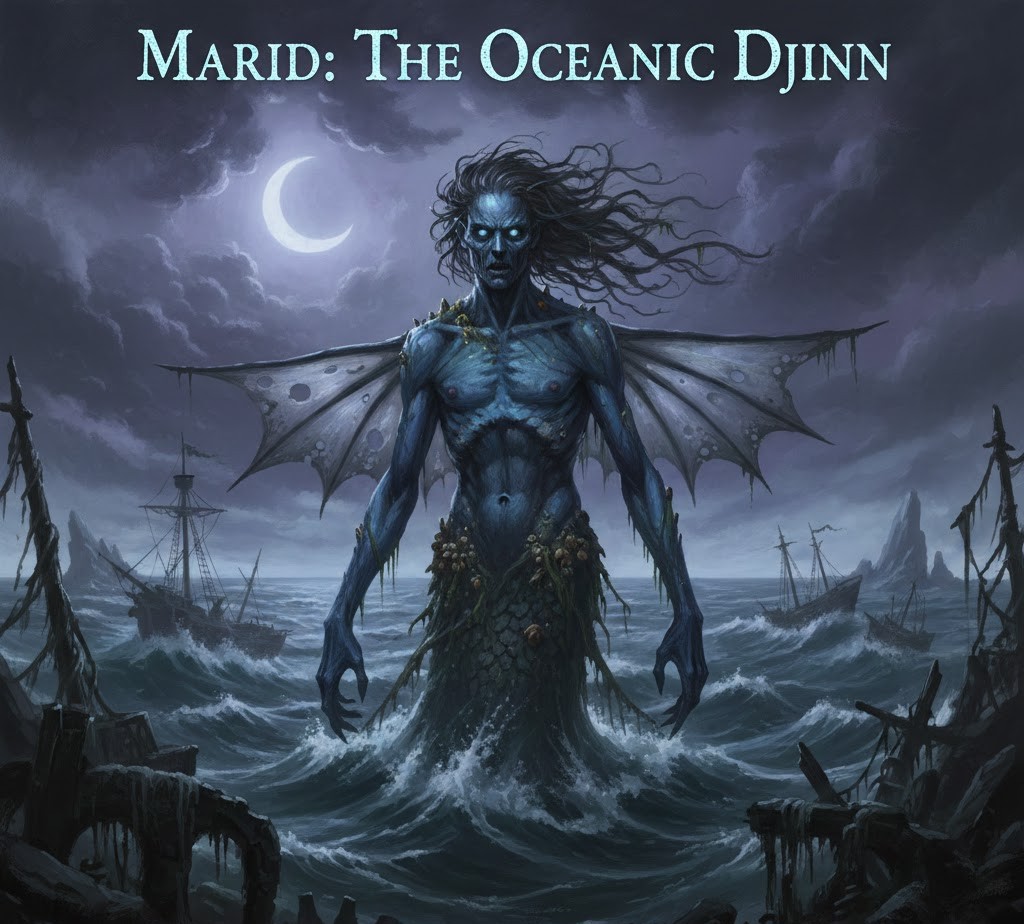
The Marid are widely regarded as the most powerful and dominant of all Djinn, feared and respected in equal measure. These formidable entities are strongly associated with water and wind, most commonly dwelling near vast oceans, storm-lashed coastlines, great rivers, and the deepest reaches beneath the sea. Their presence is often linked to violent storms, turbulent waters, and sudden, unexplainable changes in the environment.
Ancient legends and occult texts claim that Marid Djinn are capable of granting wishes, but never freely and never without consequence. Any interaction typically requires complex rituals, precise offerings, and intense bargaining, and even then, success is far from guaranteed. Marid are proud, cunning, and notoriously difficult to control, often twisting agreements to their advantage or withdrawing cooperation without warning.
In popular folklore, Marid are believed to be the inspiration behind the classic “genie in the lamp” stories from Arabian Nights. However, this romanticised portrayal is deeply misleading. Marid Djinn are not bound servants, nor are they obligated to obey human commands. Their allegiance is earned — temporarily — and always comes at a price.
Within Djinn hierarchies, the Marid stand at the top, embodying raw elemental power, ancient intelligence, and an unpredictable nature that makes them among the most dangerous Djinn encountered in paranormal tradition.
2. Ifrit – The Fire Djinn
- Element: Fire
- Personality: Fierce, intelligent and vengeful
- Abilities: Fire control, flight, shapeshifting
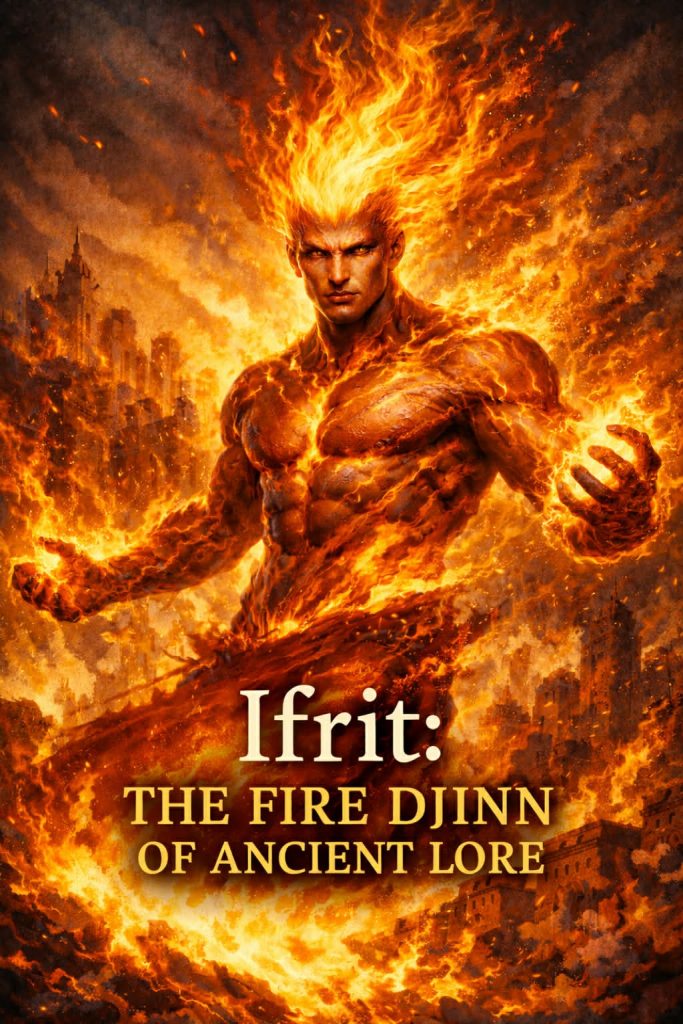
Ifrits are among the most feared and aggressive of all Djinn, commonly believed to inhabit ruins, graveyards, battlefields, deserts, and other desolate or abandoned locations where death, decay, and chaos linger. Strongly linked to fire, heat, and destruction, Ifrits are said to feed on intense energy — particularly anger, suffering, and disorder.
Often described as the warriors and enforcers of the Djinn world, Ifrits frequently manifest in monstrous or fiery humanoid forms, towering in stature and radiating overwhelming power. In Islamic folklore, some Ifrit are portrayed as rebellious entities punished for defiance, condemned to wander or remain bound within the human realm. Many are said to be tasked with guarding hidden treasures, ancient ruins, or cursed artifacts, making encounters especially dangerous.
Ifrits are notoriously hostile and prideful, traits that make them extremely difficult — and perilous — to summon or communicate with. Attempts at control often fail, as their arrogance and violent temperament lead them to resist commands or retaliate against those who dare challenge them.
Within paranormal traditions, the Ifrit are widely considered one of the most volatile Djinn types, best avoided rather than confronted.
3. Shaitan – The Demonic Djinn
- Element: Fire and Shadow
- Personality: Deceptive, manipulative and rebellious
- Abilities: Illusion, temptation and mental manipulation (much like a demonic spirit)
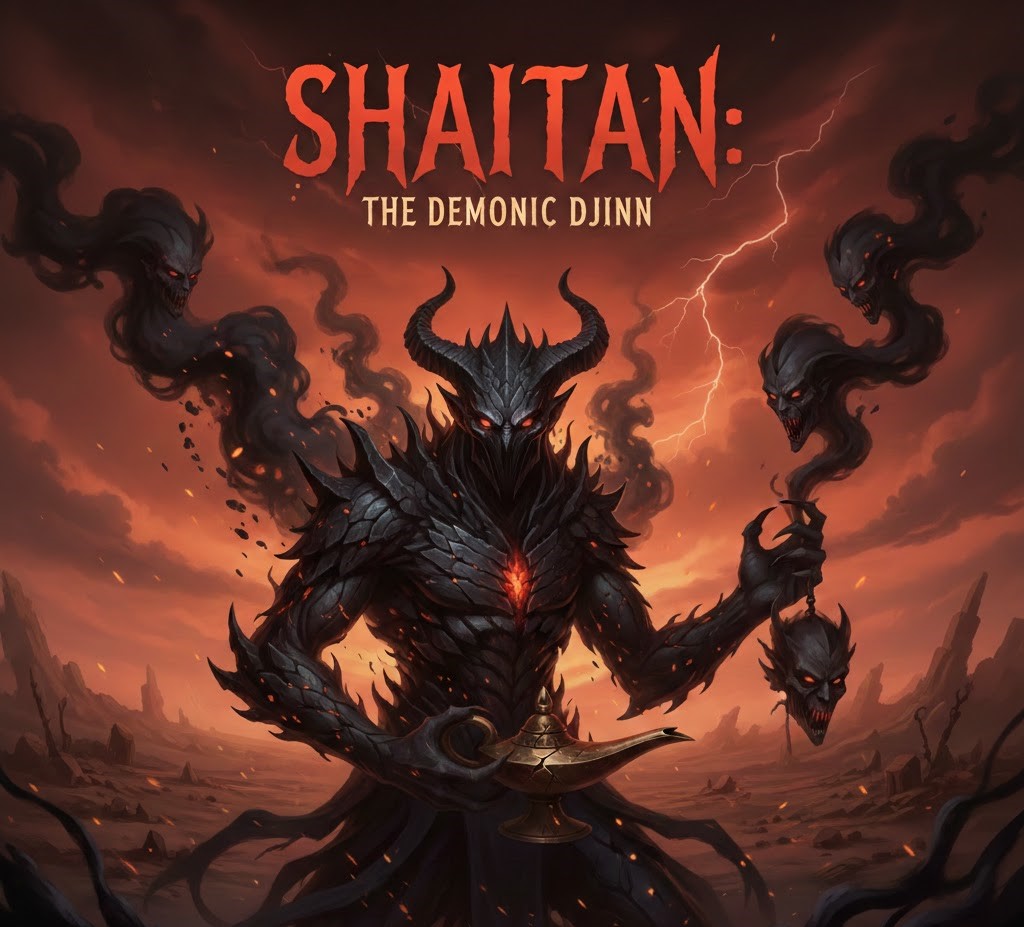
Shaitans are considered the most malicious, corrupt, and spiritually dangerous of all Djinn, embodying deception, temptation, and moral decay. Rather than relying on brute force, Shaitans operate through subtle psychological influence, whispering intrusive thoughts, sowing doubt, and exploiting human fear, desire, anger, and emotional weakness. Their power lies not in direct manifestation, but in their ability to corrupt from within.
In Islamic tradition, the Shaitans are led by Iblis, a powerful Djinn who refused to bow to Adam, an act of defiance that made him the ultimate symbol of rebellion and spiritual arrogance. His fall is said to have marked the beginning of the Shaitans’ mission: to mislead humanity and draw souls away from righteousness through manipulation rather than force.
Lore also speaks of the Qareen, often described as a personal or “shadow Djinn” assigned to every human at birth. This entity is believed to influence thoughts, amplify negative impulses, and subtly guide individuals toward harmful choices throughout their lifetime. While not always overtly evil, the Qareen’s presence represents a constant spiritual test.
Within paranormal belief systems, Shaitans are viewed as ever-present, unseen adversaries, making them among the most pervasive and insidious entities in Djinn mythology — not because they attack the body, but because they target the mind and soul.
4. Jann – The Desert Djinn
- Element: Air and Sand
- Personality: Neutral, curious, protective of their lands
- Abilities: Speed and animal shapeshifting
The Jann are the oldest race of Djinn, predating humanity itself. They dwell in deserts and ruins, often taking animal forms or appearing as dust storms.
Unlike other Djinn, the Jann are mostly neutral – they don’t seek harm but will fiercely protect their territories.
Travellers in ancient Arabia often left offerings to the Jann before crossing dangerous deserts, hoping for safe passage.
5. Ghul – The Flesh-Eating Djinn
- Element: Earth
- Personality: Savage, deceptive and predatory
- Abilities: Shapeshifting, strength, feeding on the living and dead
Ghouls are the nightmare version of Djinn – corpse-eaters and graveyard dwellers. They lure travelers into isolation, sometimes disguising themselves as lost people or animals, only to attack once their prey is alone.
The English word ghoul actually derives from this terrifying entity. In Islamic Folklore, ghouls were said to inhabit cemeteries, ruins and deserts, feeding on both flesh and spirit.
Other Notable Djinn in Lore
Beyond the primary five, lesser-known classes of Djinn appear in various traditions:
- Hinn – Wind spirits that are mostly peaceful.
- Silat (Si’lat) – Shapeshifters capable of perfect human mimicry, often seductive.
- Nasnas – Deformed half-human, half-Djinn hybrids.
- Qareen – A companion of Djinn attached to every human from birth.
- Zawba’a – King of storms and whirlwinds in occult traditions.
Each of these entities plays a different role in folklore, ranging from helpful protectors to chaotic tricksters.
The Djinn Kings and Their Hierarchy
In ancient mystical writings, seven Djinn kings are said to rule over their kind. Each governs a day of the week, a planetary force and a legion of spirits.
Examples include:
- Al-Mudhhib – King of the Sun (Sunday)
- Murrah al-Abyad – King of the Moon (Monday)
- Zawba’a – King of the Winds (Thursday)
These figures appear in Arabic grimoires and magical traditions, not mainstream Islam, yet remain a vital part of esoteric lore about the unseen world.
Are All Djinn Evil?
No.
The Djinn, like humans, have free will. Some are righteous and peaceful, others are dark and malevolent, and many simply exist alongside us unseen.
Good Djinn are said to help or protect, while the wicked – like Shaitans and Ifrit – cause harm or chaos. Their morality depends entirely on their own choices.
Real Encounters with the Djinn
Across the Middle East, Africa and even Western countries, there are countless modern reports of encounters believed to involve Djinn.
Common experiences include:
- Shadow-like figures that move faster than human sight.
- Whispers or voices calling a persons name when no one is there.
- Sudden temperature drops or gusts of hot wind indoors.
- Objects shifting, lights flickering or technology malfunctioning inexplicably.
In traditional communities, these events are often atributed to disturbing a Djinns territory – for example, urinating on old ground, moving stones or calling out into empty places at night.
Some paranormal investigators have reported spirit box and polterpod responses in Arabic or unfamiliar languages during hauntings, which they later connected to Djinn lore.
While skeptics point to psychological or environmental explanations, those who’ve experienced such phenomena firsthand often describe a distinct, intelligent presence – one that feels ancient, watchful and powerful.
How to Protect Yourself from the Djinn
Whether you believe in them as literal beings or as metaphysical energy forms, protection and respect are key.
Here are time-tested methods from both spiritual and practical perspectives:
1. Avoid Summoning or Provocation
Never attempt to summon, challenge or insult the Djinn. They are proud beings who see disrespect as an open invitation to harm.
2. Protective Words and Prayers
In Islamic traditions, reciting specific verses – especially Ayat al-Kursi or Surah Al-Baqarah – is said to repel malevolent Djinn. Even outside that faith, words of light, intent and protection carry strength against dark energies.
3. Respect Sacred and Deserted Places
Djinn are believed to inhabit ruins, caves, graveyards and deserts. If investigating such areas, always ask permission aloud and leave an offering of water or incense as a sign of respect.
4. Use Cleansing Rituals
Burning sage, frankincense or myrrh, playing calming frequencies or sprinkling saltwater are traditions ways to cleanse an area of lingering energy.
5. Wear Protective Symbols
Many cultures use silver jewelry, iron or the blue Nazar eye for protection. These are believed to repel the gaze and influence of malevolent entities.
6. Strengthen Your Energy
Fear and anger are said to attract darker Djinn. Ground yourself regularly – through meditation, prayer or mindful breathing, to maintain energetic balance and emotional strength.
Final Thoughts
The Djinn remain one of the most mysterious and misunderstood entities in the paranormal world. Whether seen as ancient spirits, elemental beings or forces of energy, their presence bridges mythology and reality.
For investigators and believers alike, understanding the Djinn means stepping into a realm older than human history, filled with power, mystery and consequence.
Respect their world and it’s said they’ll respect yours.
2 thoughts on “The Different Types of Djinn: From Fire Spirits to Ancient Desert Beings”