
Across ancient civilizations, stories persist of powerful non-human beings that exist alongside gods and humanity – entities driven by ambition, desire and cosmic purpose. In Hindu mythology, these beings are known as Asuras. Commonly mislabeled as “demons”, Asuras are far more complex, embodying primordial forces that challenge divine order and human understanding alike.
Rather than representing simple evil, Asuras reflect the eternal struggle between balance and excess, discipline and obsession, enightenment and ego. Their myths are not merely tales of gods and monsters, but symbolic maps of the universe and the human psyche.
What Are Asuras?
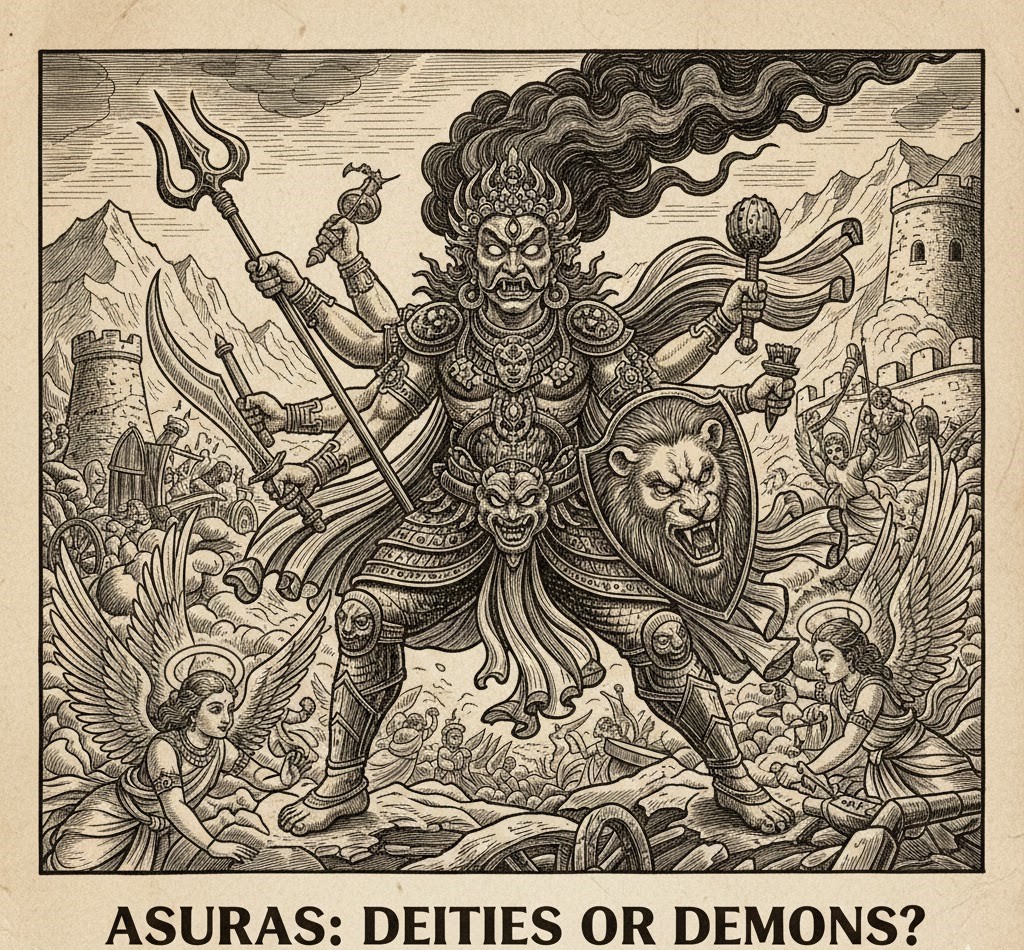
In Hindu cosmology, Asuras are powerful supernatural beings who exist in opposition to the Devas, the gods associated with cosmic order. However, this opposition is not strictly moral. The word Asura originally meant “lord”, “spirit” or “one who possesses power”. In the earliest Vedic texts, several divine beings were themselves called Asuras.
Over time the term evolved. Asuras became associated with ambition, dominance and individual will, while Devas came to symbolize harmony, sacrifice and adherence to cosmic law (Dharma). This shift reflects changing religious and philosophical priorities rather than a clear division between good and evil.
Asuras and Devas: A Cosmic Duality, Not Good vs Evil
The conflict between Asuras and Devas represents cosmic dualism, not moral absolutism.
- Devas embody order, stability and preservation
- Asuras embody change, ambition, disruption and challenge
Both forces are essential. Without Asuras, there is no resistence to overcome, no test of virtue and no catalyst for growth. Hindu cosmology teaches that balance arises not from the elimination of darkness, but from its containment and understanding.
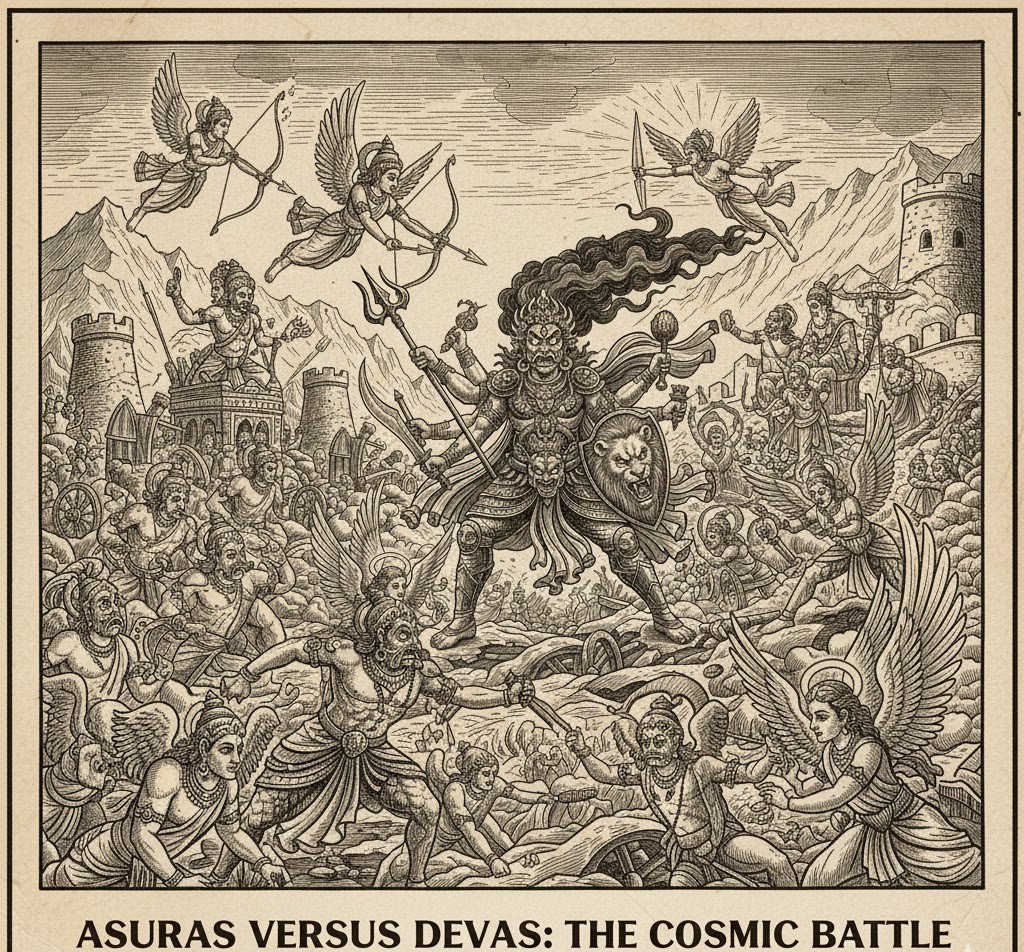
Origins of Asuras in the Vedic Age
The earliest references to Asuras appear in the Rigveda, where they are not portrayed as villains. Instead, they are primordial authorities, connected to cosmic law and creation itself.
As religious traditions evolved, particularly during the later Vedic and Puranic periods, Asuras became increasingly depicted as rivals to the gods. This transformation mirrors broader cultural challenges, where myths were reinterpreted to reinforce emerging values such as devotion, humility and social order.
The Puranic Asuras: Kings, Titans and Tyrants
In the Puranas and epic texts like the Ramayana and Mahabharata, Asuras are portrayed as mighty rulers and warriors who command vast armies and dominate entire realms.
Famous Asuras include:
- Hiranyakashipu: whose obsession with immortality and hatred of Vishnu led to his downfall at the hands of Narasimha.
- Ravana: the ten-headed king of Lanka, a brilliant scholar and devout follower of Shiva whose arrogance ultimately sealed his fate.
- Mahishura: whose tyranny necessitated the creation of Goddess Durga, symbolizing divine feminine power restoring balance.
These figures are rarely foolish or weak. Instead, they are undone by imbalance – unchecked ego, obsession with power and refusal to surrender control.
Tapasya and the Dangerous Pursuit of Power
One defining trait of Asuras is their mastery of tapasya, or intense spiritual austerity. Through extreme discipline, fasting and meditation, Asuras often earn boons from the gods – particularly Brahma or Shiva.
These boons grant near-invincibility, extended life or immunity from death, yet they almost always contain hidden limitations. The lesson is clear: power without wisdom becomes a curse.
Asuras, Maya and the Illusion of Reality
Asuras are closely linked with Maya, the illusionary nature of the material world. Many myths describe Asuras as shapeshifters, illusion-casters and builders of false realities.
Maya represents the seductive pull of:
- Wealth
- Power
- Control
- Physical dominance
Asuras believe reality can be conquered rather than understood. Their downfall comes when illusion is mistaken for truth, trapping them within their own creations.
Asura Realms and Cosmic Geology
Hindu cosmology describes a multilayered universe in which Asuras inhabit opulent subterranean realms, collectively known as the Patalas.
These include:
- Patala
- Rasatala
- Talatala
- Mahatala
Far from being hellish, these realms are often described as more magnificent than heaven itself – filled with advanced cities, riches and powerful energies. This reinforces a recurring theme: luxury and power are not indicators of spiritual progress.
Asuras as Master Builders and Lost Civilizations
Asuras are frequently depicted as master architects. The legendary city of Tripura, a triple fortress spanning land, sea and sky, symbolizes ulimate technological and magical supremacy.
Some modern theorists interpret these myths as echoes of:
- Lost ancient civilizations
- Forgotten technologies
- Symbolic memories of pre-historic cultures
While speculative, these ideas have contributed to ongoing paranormal and alternative-history discussions.
The Feminine Divine and the Fall of Asuras
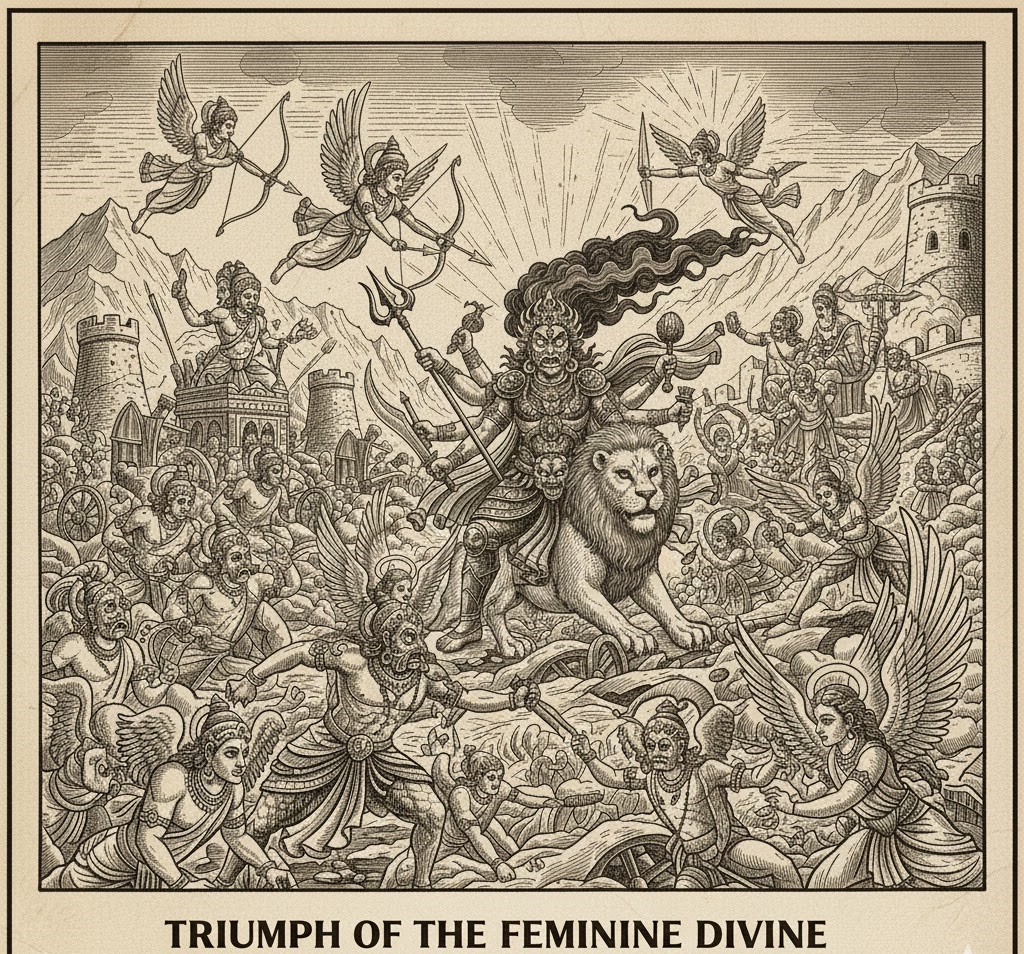
Notably, many Asuras are defeated not by male gods, but by manifestations of the Divine Feminine.
Goddesses such as Durga, Kali and Chamunda emerge specifically to counter Asuras dominance. Their victories symbolize the necessity of balance – force tempered by compassion, power retrained by wisdom.
Asuras in Buddhism and Jainism
In Buddhism, Asuras inhabit one of the six realms of existence, characterized by jealousy, aggression and endless conflict. They are not punished beings, but victims of their own nature.
Jain cosmology also includes powerful beings similar to Asuras, with emphasis placed on karma and spiritual consequence rather than divine warfare.
Psychological and Symbolic Interpretations
From a psychological perspective, Asuras represent the shadow self – repressed desires, ambition, anger and fear. Hindu philosophy teaches that denying these forces strengthens them.
True spiritual growth comes from mastery, not suppression.
Asuras in Ritual, Festival and Living Tradition
Asuras remain active within cultural memory through festivals such as:
- Durga Puja
- Dussehra
In some indigenous traditions, Asuras are even honored as ancestral figures, demonstrating the layered complexity of their legacy.
Modern Paranormal Interpretations
In contemporary paranormal discourse, Asuras are sometimes interpreted as:
- Ancient non-human intelligences
- Interdimensional entities
- Archetypal consciousness forces
While not traditional views, they reflect humanities enduring attempt to understand encounters with the unknown.
The Eternal Return of the Asuras
Asuras are never permanently destroyed. In Hindu cosmology, they return whenever imbalance arises. Their existence is cyclical, mirroring the eternal rhythm of creation, destruction and renewal.
Conclusion: Understanding the True Nature of the Asuras
Asuras are not demons in the Western sense. They are forces of will, ambition and transformation, essential to the cosmic balance.
Their myths endure because they reflect timeless truths: power must be balanced, desire must be disciplined and darkness must be understood rather than denied.
To study the Asuras is to confront the dangerous potential within consciousness itself – and to recognise that enlightenment is not achieved by destroying darkness, but by mastering it.
Related posts:
- The Fae: A Complete In-Depth Look at the Fair Folk
- Succubus and Incubus: Dark Demons of Desire
- Demonic Entities Explained: Real Encounters & How Possession Works
- Residual Haunting vs. Intelligent Haunting: Understanding the Difference Between the Two
- Leylines, Crossroads & Natural Paranormal Hotspots: Why These Locations Amplify the Paranormal