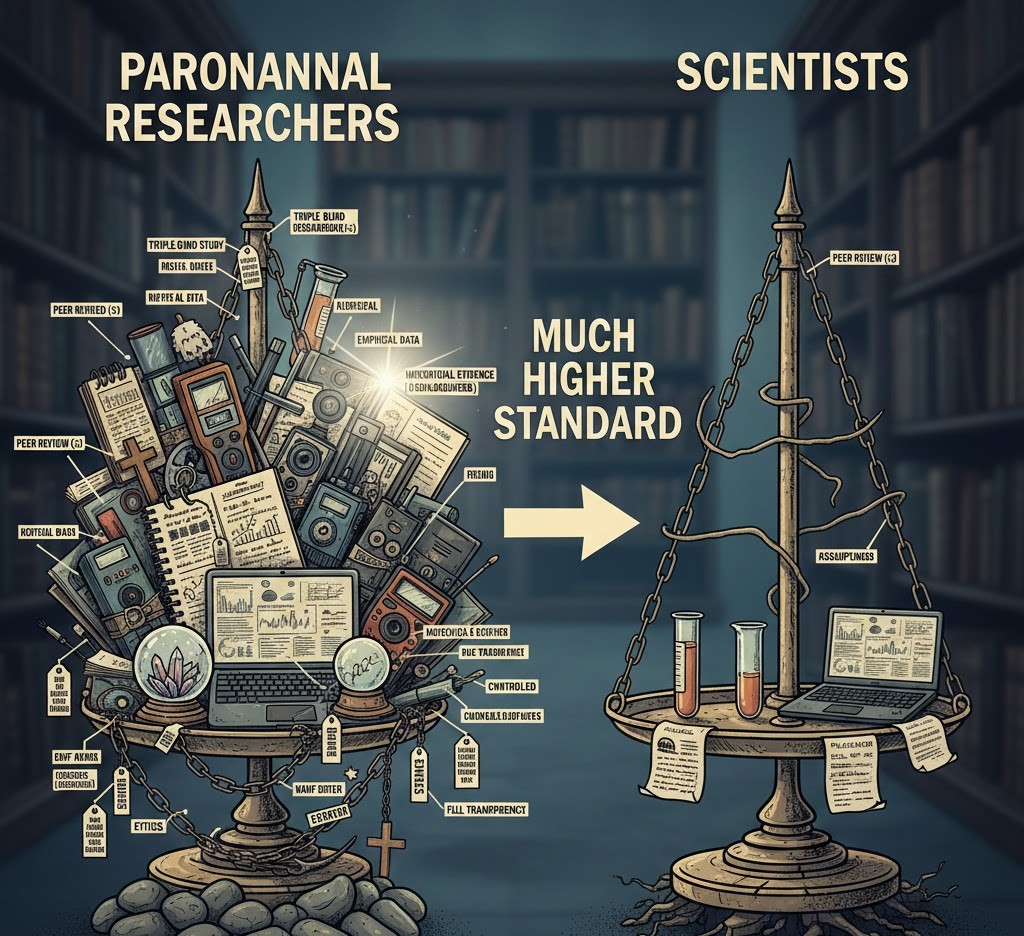
The comparison between paranormal researchers and scientists is often framed through a flawed lens – one that assumes controlled experimentation is the highest possible standard of investigation. In reality, this assumption collapses when applied to genuine, real-world phenomena. Paranormal research operates in environments where variables cannot be manipulated, and outcomes cannot be forced. Because of this, paranormal researchers are required to hold themselves to broader, stricter and more realistic standards than conventional scientists working within artificial conditions.
Paranormal research is not about proving a theory in a lab. It is about understanding phenomena as they exist in the real world – across locations, people, history and time.
Controlled Science vs Real-World Investigation
Traditional science relies on control. Variables are reduced, environments are stabilised and outcomes are expected to repeat under identical conditions. This methodology is powerful – but only within limited domains.
Paranormal phenomena do not just occur under controlled conditions – hence the word research and investigation.
They emerge in unpredictable environments, emotionally charged locations, historically significant sites, natural landscapes, private homes and across generations. All of which is a small amount of information taken into consideration. Attempting to manipulate these environments to achieve artificial repetition removes the very conditions that allow the phenomena to occur in the first place.
Paranormal researchers do not simplify reality to make it measurable to fit their agenda – they study reality as it is.
Paranormal Researchers Study Everything, Not Just What Can be Controlled
One of the most significant differences between paranormal research and conventional science is scope.
Science often limits its inquiry to what can be isolated, quantified and controlled. Paranormal research expands its inquiry to include all contributing factors, even when they are difficult – or currently impossible – to measure.
Environmental conditions, human perception, emotional states, historical context, cultural belief systems, locations-specific patterns, equipment limitations, observer influence, natural explanations and unknown variables are all examined together rather than excluded.
This expansive approach requires greater discipline, not less.
Verification Through Repeated Investigation – Not Artificial Replication
Paranormal researchers do not attempt to artificially recreate phenomena under forced conditions. Instead, verification occurs through repeated investigation over time, across changing environments and circumstances.
This includes:
- Multiple investigations of the same location
- Independent teams observing similar phenomena
- Long-term witness reports
- Historical records aligning with modern experiences
- Consistent behavioural patterns emerging over time
Consistency despite changing conditions is considered more meaningful than repetition achieved by environmental manipulation.
Repeatable Evidence That is Documented – and Dismissed
One of the most critical points often ignored in this debate is that repeatable evidence does exist in paranormal research. It simply does not present itself in the narrow way controlled science demands.
Across decades of investigation, paranormal researchers have documented:
- Orbs reacting to verbal commands in different locations
- Apparent intelligent responses that change based on interaction
- Electronic Voice Phenomena (EVPs) capturing the same distinct voice across multiple sites
- Identical vocal characteristics appearing in separate locations with no matching human source present
In some cases, the same paranormal research team – comprised entirely of women – has recorded a consistent male voice responding across multiple, unrelated locations. The locations differ. The acoustics differ. The people present remain the same. Yet the voice characteristics remain consistent.
This is repeatability across space and time, not within a single, artificially controlled environment – which allows a lot more accuracy in research, rather than only taking small amounts of information into account.
Scientific methodology typically refuses to engage with this type of evidence – not because it lacks consistency, but because it cannot be confined to one location and forced to occur on demand. Data that spans multiple locations, multiple investigations and extended timeframes does not fit neatly into laboratory-based validation models, and is therefore dismissed rather than analysed.
This dismissal reflects the limitation of methodology, not a failure of evidence. This methodology only allows for human interpretation, rather than allowing every factor to be considered, researched, studied and investigated.
Connecting Phenomena Across Locations and Time Periods
Paranormal research places significant importance on identifying connections across:
- Different locations
- Different time periods
- Different witnesses
- Different cultural contexts
When similar phenomena emerge independently across unrelated environments, those connections become vital data points. Pattern recognition across space and time has always been foundational to genuine scientific progress.
Paranormal researchers actively track these connections rather than ignoring them because they are inconvenient.
Research That Evolved With the Evidence
Paranormal research is not bound to static models. Interpretations evolve as new investigations are conducted, technology improves and broader patterns emerge.
Researchers openly accept that earlier conclusions may change and that understanding deepens over time. This flexibility is not a weakness – it is a hallmark of honest inquiry.
Science Demands Certainty; Paranormal Research Accepts Reality
Conventional science often requires certainty before engagement. Paranormal research accepts uncertainty as part of investigation.
Rather than rejecting phenomena that do not immediately fit existing frameworks, paranormal researchers document, analyse and revisit data as understanding evolves.
This is how knowledge has always advanced.
“Technical Glitches” as a Scientific Dismissal Tool – Not an Investigative Conclusion
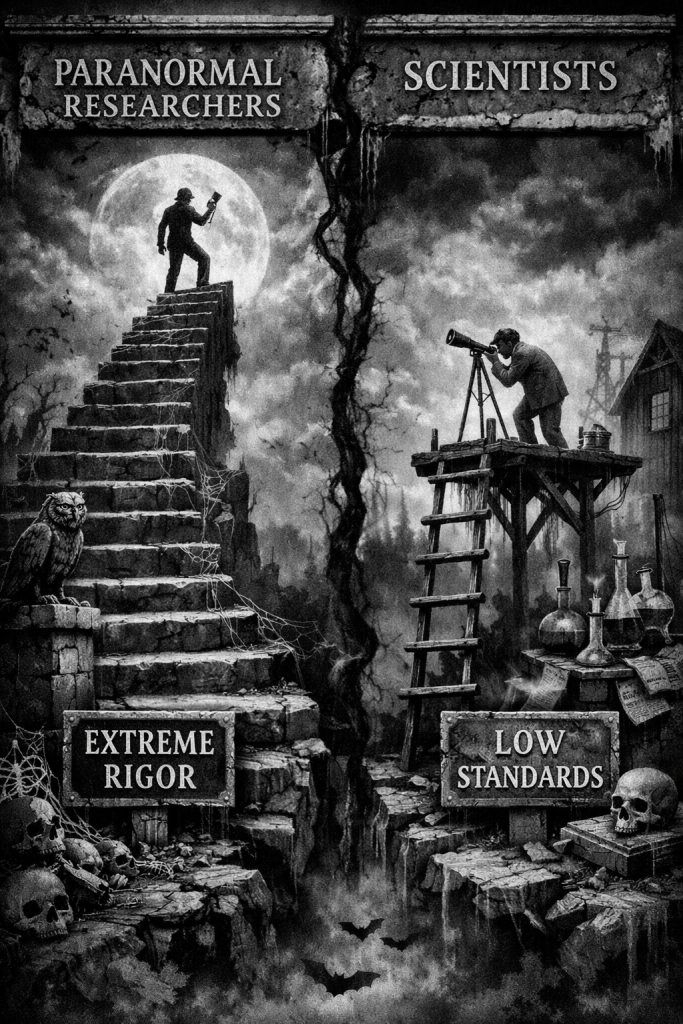
One of the most common ways paranormal research is dismissed by scientists is through the broad, often unexamined claim of “technical glitches”. This explanation is frequently presented as a definitive debunking, despite the fact that no investigation into the alleged fault has actually taken place.
Rather than analysing anomalous data, many critics simply attribute it to equipment malfunction and move on. This is not a scientific conclusion – it is a human-made assumption, going against everything the scientific community holds up to its “standards”. Paranormal researchers recognise this distinction, which is why potential technical issues are treated as questions requiring investigation, not as automatic explanations.
Paranormal Researchers Do Not Accept Conclusions Without Investigation and Testing
Paranormal researchers fully acknowledge that equipment can fail. Audio recorders can introduce artefacts, cameras can misinterpret light, electromagnetic interference can affect sensors and environmental conditions can alter readings. However, acknowledging the possibility of malfunction is not the same as using it as a blanket dismissal.
When scientists cite “technical glitches” as a debunking mechanism, they often do so without:
- Replicating the supposed fault – when they do they dismiss the fact that fault is not present every time it happens
- Demonstrating how the anomaly was produced – using a separate, forced environment rather than allowing what was naturally accuring
- Testing the equipment under comparable conditions
- Accounting for why the anomally occured selectively
Paranormal Researchers, by contrast, require proof that a glitch actually occured before accepting it as an explanation.
Investigation Comes Before Dismissal
In genuine paranormal research, an anomally initiates investigation – it does not conclude and bring an end to it.
Researchers examine:
- Whether the anomaly appears across multiple devices
- Whether it occurs repeatedly or only once
- Whether environmental interference could realistically account for it
- Whether similar anomalies occur in unrelated locations
- Whether the anomaly correlates with other independent data
If a technical cause can be demonstrated, the data is discarded. If it cannot, the anomaly remains unsolved – not labelled as paranormal, but also not erased. Is it considered “possible paranormal phenomena” – no conclusion is made off an indecisive conclusion.
The process reflects scientific integrity over assumption-based dismissal.
Why “It’s Just a Glitch” Is Not an Answer
Labeling unexplained data as a “glitch” without evidence does not make it false – it simply removes it from consideration. That approach protects existing frameworks rather than advancing understanding.
Throughout scientific history, many discoveries were initially dismissed as instrument error before later being recognised as meaningful data. Paranormal researchers understand this pattern and therefore refuse to accept technical explanations that cannot themselves be demonstrated.
A claim of malfunction must meet the same standard as any other explanation: it must be shown, not assumed.
Elimination, Not Convenience, Defines Paranormal Research
Paranormal research does not treat anomalies as proof. It treats them as problems to be investigated and solved.
Most anomalous data is eliminated through technical testing, environmental analysis or human error. Only a small fraction survives this process – and even then, it is labelled as unexplained rather than definitively paranormal.
By contrast, dismissing anomalies because they challenge controlled models prioritises convenience and human interpretation over investigation.
A Methodology That Accepts Uncertainty
Paranormal researchers openly accept that:
- Some anomalies will have technical explanations
- Some will have natural explanations
- Some will remain unexplained with current knowledge
Unexplained does not equal paranormal – but it also does not equal meaningless.
By refusing to accept unproven dismissals, paranormal research maintains a methodology that evolves with evidence rather than retreating from it.
Dismissal is Not Debunking
Calling an anomaly a “technical glitch” without proof is not debunking – it is avoidance.
Paranormal researchers demand evidence for every explanation, including sceptical ones. This insistence on verification, rather than human assumption, reflects a higher standard of inquiry – one that recognises that understanding does not advance by ignoring what we cannot yet explain.
Final Thoughts: Paranormal Research Holds itself to a Higher, Broader Standard
Paranormal researchers do not reject science – they challenge its limitations.
They investigate reality as it exists.
They verify through repeated investigation, not forced environments.
They recognise repeatable patterns across locations and time.
They accept uncertainty and evolving knowledge.
They reject far more evidence than they accept.
Paranormal research does not claim to have all the answers.
It claims something far more scientifically honest:
That reality does not occur in controlled environments – and understanding it requires studying it where it actually exists.