Within demonology and paranormal research, possession represents one of the most complex and confronting forms of spiritual interference. Unlike hauntings or external manifestations, possession is understood as an internal invasion – an entity exerting influence from within the human body and consciousness. Across centuries, cultures and religions, possession accounts display consistent patterns, behaviours and stages, suggesting phenomenon deeply embedded in human spiritual experience.
While modern investigations acknowledge psychological factors, possession within the paranormal framework is not dismissed as mere pathology. Instead, psychological assessment is used as a necessary filter – helping investigators distinguish between mental illness, trauma, responses and genuine anomalous activity. In cases where psychological explanations fail to account for the full scope of reported phenomena, possession remains a serious and unresolved possibility.
Possession in Paranormal Tradition
Belief in possession exists in nearly every culture on Earth. From demonic entities in Christian theology to Djinn in Islamic tradition, dybbuks in Jewish mysticism and hostile spirits in Indigenous belief systems, the core concept remains unchanged: a non-human intelligence intrudes upon a living person, gradually asserting control.
What is often overlooked is that possession is rarely portrayed as sudden. Ancient texts and modern case files alike describe a slow deterioration – an erosion of boundaries rather than an immediate takeover. This progression is why possession is treated with caution even among paranormal researchers.
In traditional demonology, possession is never the first stage of contact. It is the final outcome of prolonged exposure, vulnerability and unchecked influence.
Defining Possession Within Demonology
Demonological doctrine defines possession as the partial or total occupation of a human body by a non-human entity, resulting in compromised autonomy. Importantly, possession is not believed to destroy the soul. The soul remains present but supressed, overshadowed or restrained while the entity exerts control over physical and mental functions.
This distinction matters. Possession is not death, replacement or transformation – it is domination.
Within paranormal belief systems, possession is understood as an invasive act requiring opportunity. That opportunity may arise through emotional trauma, spiritual imbalance, deliberate contact or prolonged exposure to negative or hostile entities.
Vulnerability and Spiritual Exposure
Paranormal belief systems consistently identify vulnerability as a key factor in possession cases. Individuals experiencing prolonged emotional distress, grief, fear or identity crisis are considered more susceptible – not because they are weak, but because their spiritual and psychological defences are compromised.
Other commonly cited vulnerabilities include:
- Engagement in unsafeguarded spirit communication
- Obsession with dark or forbidden knowledge
- Repeated exposure to negative entities or locations
- Loss of spiritual grounding or belief structure
Psychological assessment becomes relevant here – not to disprove possession, but to establish a baseline. Investigators must determine whether experiences stem solely from internal causes or whether external influence may be present.
The Stages of Possession
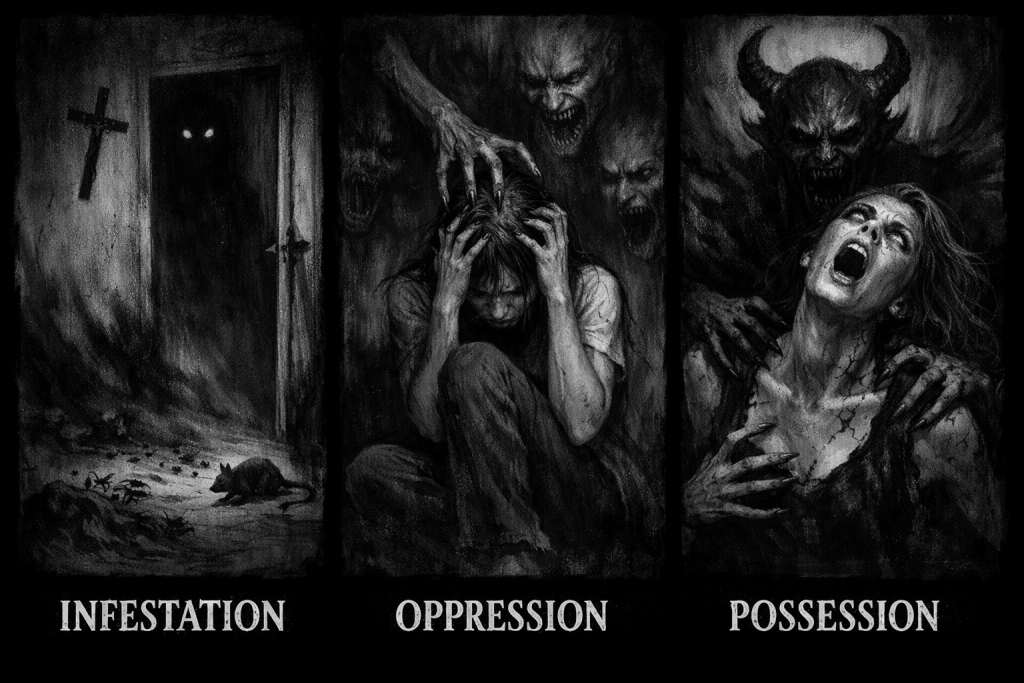
Within modern paranormal investigation and demonological study, possession is not viewed as a sudden or spontaneous event. It is understood as the final stage of a progressive process that begins externally and gradually moves inward. This progression is consistently described across case files, religious doctrine and contemporary investigative frameworks.
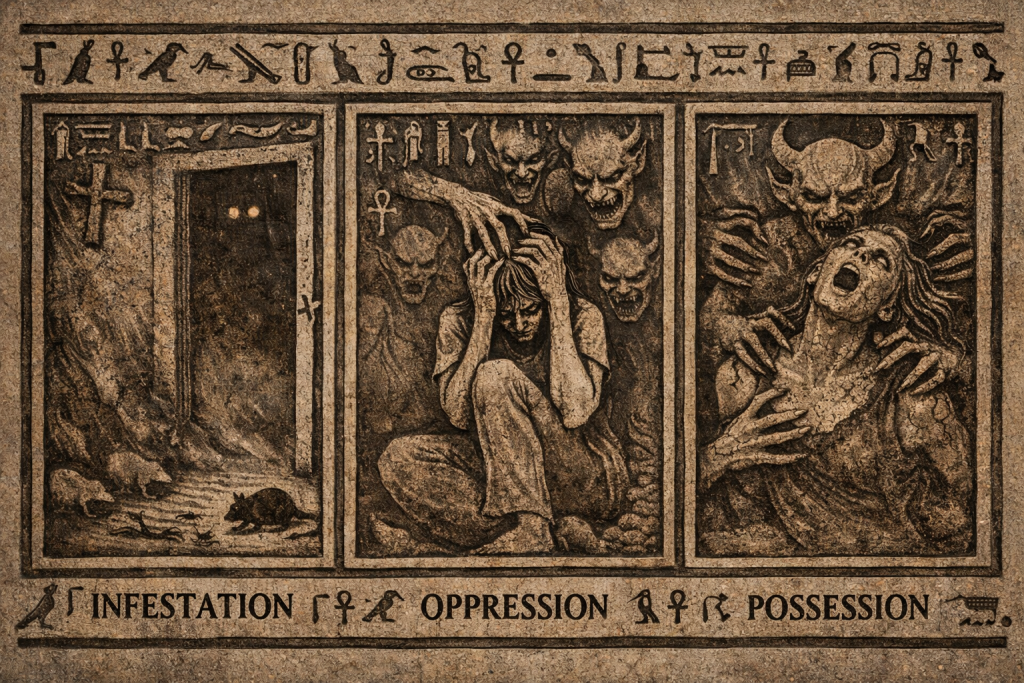
The stages are commonly identified as infestations, Oppression and Possession. Each represents an escalation in influence, not merely an increase in activity.
Stage 1: Infestation
Infestation is the earliest stage and the most frequently encountered. At this point, the entity has not attached itself to the individual directly, but has established a presence within their immediate environment. Activity tends to follow the person rather than remain confined to a single location, which is a key distinction from traditional hauntings.
Infestations is often linked to exposure – whether through unsafeguarded spirit communication, repeated interaction with negative locations, or prolonged emotional vulnerability. Once established, the entity tests boundaries, observing reactions and feeding on fear or attention.
Common signs associated with infestations include:
- Unexplained noises such as footsteps, knocking or scratching
- Objects being moved or displaced
- Shadow figures or movement in peripheral vision
- Sudden cold spots or changes in atmosphere
- Disturbed sleep, nightmares or recurring night terrors
During infestations, the individual remains fully autonomous. The disturbance is external, but persistent. Fear plays a significant role at this stage, as heightened emotional responses appear to strengthen the entities presnce.
Stage 2: Oppression
Oppression represents a shift from environmental disturbances to personal targeting. The activity becomes focused on weakening the individual emotionally, mentally and spiritually. Rather than manifesting primarily through physical phenomena, oppression operates through sustained psychological pressure.
This stage is characterised by a gradual erosion of stability. The individual may feel overwhelmed, isolated or hopeless without an identifiable cause. Relationships often deteriorate and daily functioning becomes increasingly difficult.
Common indicators of oppression include:
- Persistent despair, dread or emotional heaviness
- Sudden personality changes, irritability or anger
- Withdrawal from family, friends or spiritual practices
- Heightened anxiety or panic
- Discomfort around protective or sacred symbols
At this stage, psychological evaluation is essential. Conditions such as depression, anxiety and trauma responses can present with similar symptoms and must be carefully ruled out. In cases considered paranormally significant, oppression is accompanied by ongoing infestation phenomena or corroborated experiences witnessed by others.
Oppression remains reversible. Intervention at this stage is often effective and can prevent further escalation.
Stage 3: Possession
Possession is the final and least common stage. It involves direct control over the individuals physical body by a non-human entity. This control is typically intermittent rather than constant, occurring during periods of exhaustion, emotional collapse or weakened resistance.
Possession is understood as domination rather than replacement. The individuals consciousness is suppressed but not destroyed, often described as being trapped or observing without the ability to intervene.
Signs associated with possession include:
- Altered voice, speech patterns or facial expression
- Periods of lost time or unexplained blackouts
- Extreme reactions to protective symbols or sacred objects
- Physical contortions or unusual strength
- Claims of identity or communication by the entity
At this stage, conventional psychological approaches alone are insufficient. While mental health support remains important, possession is believed to require spiritual intervention aimed at removing the intrusive presence rather than treating symptoms.
Why This Framework Endures
The strength of this three-stage model lies in its restraint. By recognising that possession is rare and preceded by identifiable warning stages, it avoids sensationalism while still acknowledging the seriousness of genuine cases.
Most reported cases never progress beyond infestation or oppression. When they do, it is often due to prolonged exposure, lack of intervention or reinforcement through fear or belief.
Spiritual Intervention in Possession Cases: Restoring Personal Authority
In paranormal belief systems, spiritual intervention during possession cases is often misunderstood as an aggressive act intended to forcibly remove a non-human entity. While this approach dominates popular culture, many investigators and belief-based practitioners view intervention very differently. Rather than focusing on confrontation, spiritual intervention is understood as a process of restoring the affected individuals strength, autonomy and spiritual authority.
Within this framework, possession is not maintained by the entities power alone, but by a breakdown in personal boundaries. Intervention therefore prioritises empowerment over expulsion.
The Purpose of Spiritual Intervention
The primary goal of spiritual intervention is not to engage the entity directly, but to stabilise and reinforce the individual experiencing the influence. Paranormal case studies consistently suggest that entities exploit vulnerability rather than force entry. Emotional trauma, fear, exhaustion and identity disruption are viewed as openings that allow influence to persist.
Spiritual practices – such as prayer, ritual grounding, protective symbols or belief-based reaffirmation – are used to strengthen these weakened boundaries. The practitioners role is not to dominate the situation, but to guide the individual back into a position of control.
Why Personal Strength is Central to Expulsion
In belief-based possession models, lasting resolution occurs when the individual actively rejects the entities presence. Expulsion is not seen as something done to the person, but something done by them, supported by spiritual guidance.
This explains why interventions often fail when individuals remain passive or disconnected from the process. Without belief, intention and personal engagement, external rituals alone have limited effect. Conversely, when individuals reclaim agency and reinforce their sense of self, entities are believed to lose access naturally.
The act of expulsion is therefore understood as a consequence of restored authority, not a dramatic confrontation.
Reframing Possession and Intervention
This belief-based approach reframes possession as a crisis of autonomy rather than a battle between external forces. Spiritual intervention succeeds not through force, but through empowerment – by helping individuals reclaim control over their inner and outer boundaries.
When authority is restored, influence diminishes.
And when access is denied, the entity has nowhere left to remain.
Leading into Protection and Safeguards
Understanding these stages provides context for why protection symbols, rituals and belief-based safeguards exist across cultures. They are not tools of confrontation, but methods of prevention – designed to reinforce boundaries before external influence becomes internal domination.
The next part of this demonology series will examine those safeguards in detail, exploring how symbols and beliefs function as barriers against infestation, oppression and ultimately, possession.
Because in paranormal belief systems, the most effective defence is not resistance –
It is control of access.
Related Posts:
- Demonology101 – Part VI: Half Demons & Demon Hybrids
- Demonology101 – Part V: Archetypes and the Hierarchy of Demonology
- Demonology101 – Part IV: Cultural and Religious Demonology
- Demonology101 – Part III: Misconceptions & Myths
- Demonology101 – Part II: Origins and Evolution
- Demonology101 – Part I: Introduction to the Study of Demonology
This is fascinating….could explain a lot going on with me