As we continue our deep dive into witches, witchcraft and their history across cultures and centuries, it is essential to begin with one of the most commonly referenced – and most misunderstood – figures in global spiritual tradition: the witch doctor.
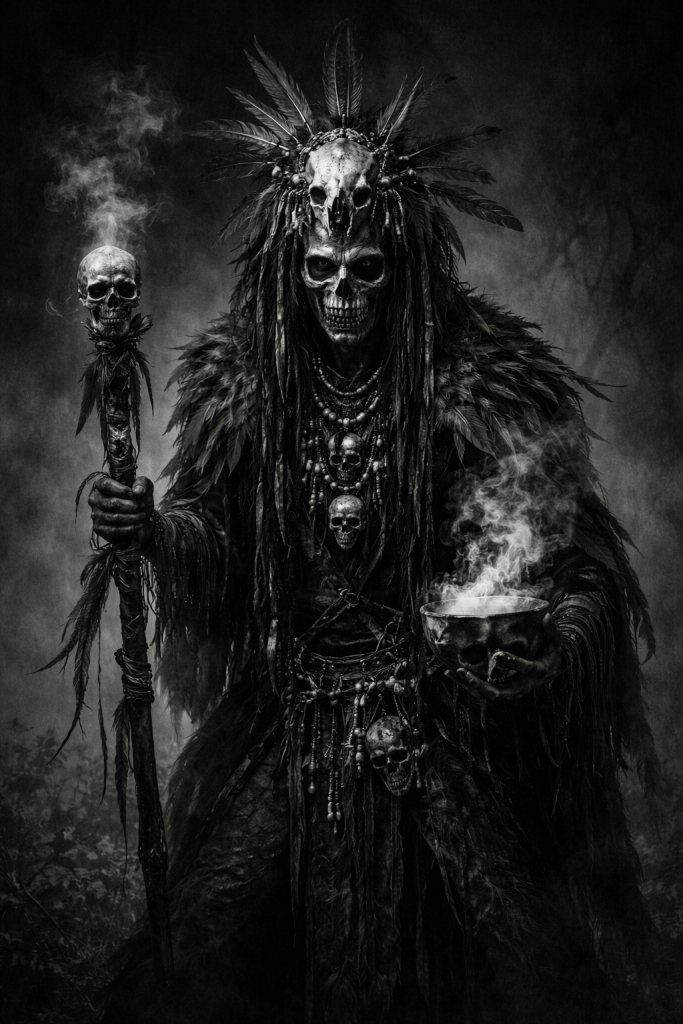
Popular media has distorted this term into a caricature – bones, face paint, curses and theatrical rituals. But the reality is far deeper, more complex and far more culturally significant. The witch doctor is not merely a figure of folklore. In many societies, they are healers, spiritual intermediaries, protectors, herbalists, diviners and community elders.
To understand the witch doctor is to understand the spiritual foundations of entire civilizations.
What is a Witch Doctor?
The term witch doctor is a Western umbrella phrase – one that flattens diverse and highly structured spiritual traditions into a single, misleading label.
Historically, European colonists and missionaries used the phrase to describe African spiritual healers who diagnosed spiritual illness, countered malevolent magic and mediated between the living and ancestral realms. The label implied superstition or sorcery. In reality, these practitioners were – and remain – highly trained ritual specialists operating within sophisticated cosmological systems.
Importantly, in many African traditions, a “witch” is someone who causes harm through spiritual means. The healers role is to identify, neutralise and restore balance in response to that harm. In that sense, the so-called witch doctor is not a sorcerer – but a protector.
Across Africa, there is no single title for this role. Instead, each culture has its own name, structure, training system and spiritual framework. Below are three of the most well-known and historically significant examples.
The Sangoma
Pronunciation: sahn-GOH-mah
The Sangoma is a traditional healer and diviner found primarily among Zulu, Xhosa, Swazi and Ndebele peoples of Southern Africa.
Origins and Caling
Becoming a Sangoma is not a casual decision. It is believed to be a spiritual calling from the ancestors – often revealed through persistent dreams, unexplained illness, visions or psychological distress interpreted as ancestral communication.
This calling process is known in Nguni cultures as thwasa – a spiritual awakening that compels the individual to train.
Training can last several years and is conducted under the supervision of an experienced Sangoma. It involves:
- Learning ancestral cosmology
- Mastering divination techniques (often bone casting)
- Studying medicinal plants
- Ritual purification practices
- Ethical and community obligations
Core Functions
A Sangoma typically serves as:
- Diviner
- Herbalist
- Spiritual counselor
- Medium for ancestral spirits
- Ritual specialist
Divination is central. The Sangoma casts a collection of bones and symbolic objects onto a mart and interprets their arrangement according to ancestral guidance. This system is structured and codified – not random.
Cultural Standing
In modern South Africa, traditional healers – including Sangomas – are legally recognised, and millions consult them each year. In many communities, they hold immense respect as custodians or spiritual and cultural continuity.
The Nganga
Pronunication: n-GAHN-gah (the first “n” is lightly nasal)
The Nganga is a ritual specialist found primarily in Central and West-Central Africa, particularly among Kongo-speaking peoples.
The term Nganga broadly refers to someone with deep knowledge – especially spiritual, medicinal or ritual knowledge.
Spiritual Framework
In Kongo cosmology, the universe is divided between the visible world (the living) and the invisible world (ancestors and spirits). The Nganga serves as mediator between these realms.
They may oversee sacred objects known as nkisi – spiritual containers believed to house specific forces or entities. These are not “cursed idols”, as colonial accounts often described them, but complex ritual instruments designed for healing, justice, protection or oath-taking.
Roles and Responsibilities
The Nganga may function as:
- Herbalist
- Spiritual judge
- Protector against witchcraft
- Keeper of sacred ritual objects
- Community advisor
Unlike sensationalised portrayals, the Ngangas work is highly regulated within cultural law and spiritual codes. Ritual misuse is believed to carry serious consequences.
Colonial Distortion
During colonial expansion, sacred nkisi figures were frequently seized and displayed in European museums as evidence of “primitive superstition”. This profoundly distorted global perceptions of the Nganga tradition, stripping it of its theological and philosophical depth.
The Babalawo
Pronunciation: bah-bah-LAH-woh
The Babalawo is a high priest of the Ifa divination system within Yoruba spirituality, which originates in present-day Nigeria and extends throughout West Africa and the African diaspora.
The word Babalawo translates roughly to “father of secrets” or “father of mysteries”.
The Ifa System
Ifa is an intricate divination corpus composed of hundreds of sacred verses known as odu. These verses contain mythology, ethical teachings, cosmology and practical guidance.
The Babalawo undergoes extensive training – often spanning many years – to memorise and interpret this system accurately.
Divination is performed using sacred palm nuts or a divination chain, producing binary patterns that correspond to specific odu texts. Interpretation requires deep theological knowledge.
This is not improvised mysticism – it is a structured intellectual tradition.
Theological Foundation
Yoruba cosmology acknowledges:
- A supreme creator
- A pantheon of divine forces (Orisha)
- Spiritual destiny (ori)
The Babalawos role is to help individuals align with their destiny, resolve spiritual imbalance and maintain harmony between visible and invisible realms.
Diaspora Influence
Through the transatlantic salve trade, Yoruba spiritual systems spread to the Americas, influencing traditions such as:
- Santeria
- Condomble
- Vodou
In these traditions, Ifa and the Babalawo remain central figures of spiritual authority.
Origins and Historical Roots
The roots of the witch doctor trace back thousands of years – long before organised Western religion. Archaeological and anthropological evidence suggests that early human societies relied heavily on spiritual intermediaries who bridges the physical and unseen realms.
In sub-Saharan Africa, spiritual healing traditions developed within animistic cosmologies – belief systems in which:
- All things possess spirit
- Ancestors remain active in lives of the living
- Illness can have spiritual as well as physical causes
- Balance between realms is essential for survival
These traditions existed independently long before European contact.
During the colonial period, missionaries and explorers frequently misunderstood or deliberately misrepresented these practitioners. Ritual healing was framed as superstition. Ancestral veneration was labeled paganism. Protective rituals were described as sorcery.
This misunderstanding shaped the modern stereotype of the witch doctor – a stereotype that still persists in horror films and pulp fiction.
Understanding Animistic Cosmology
To full grasp the origins of the witch doctor, we must understand the spiritual framework many of these traditions developed within: animistic cosmology.
Defining Animism
Animism is one of the oldest known spiritual worldviews in human history. The term was popularised in the 19th century by anthropologist Edward Burnett Tylor, though the belief system itself predates written history by tens of thousands of years.
At its core, animism is the belied that all things possess spirit or life-force.
This includes:
- Humans
- Animals
- Plants
- Rivers
- Mountains
- Weather systems
- Objects of ritual significance
The world is not divided into “living” and “non-living”. Instead, existence is relational and spiritually interconnected.
What Does “Cosmology” mean?
A cosmology is a cultures understanding of how the universe is structured – how the physical, spiritual, ancestral and natural realms interact.
In animistic cosmology:
- The physical and spiritual worlds overlap
- Ancestors remain active participants in daily life
- Illness may stem from spiritual imbalance
- Natural events can carry intention or meaning
- Harmony between visible and invisible realms is essential for survival
There is no strict separation between religion, medicine and community law. A spiritual disturbance may manifest physically, socially or environmentally.
This integrated worldview shaped early healing systems across Africa, Asia, the Americas and parts of Europe long before institutional religions formed rigid theological boundaries.
The Living Universe: Interconnection and Reciprocity
Animistic cosmology views the universe as alive – not metaphorical, but literally.
Spirits inhabit landscapes. Ancestors guide descendants. Animals may act as messengers. Sacred objects are not symbolic – they are spiritually inhabited.
Because everything is spiritually interconnected, balance becomes central. When relationships between humans, ancestors, land or spirits are disputed, consequences follow.
Healing therefore becomes less about “curing a symptom” and more about restoring harmony within a web of relationships.
Colonial Misinterpretation of Animism
For centuries, Western scholars and missionaries characterised animism as a “primitive” or early stage of religious evolution.
This perspective – influenced heavily by 19th century evolutionary anthropology – dismissed animistic systems as irrational superstition.
Modern scholarship increasingly recognises this framing as reductive.
Animistic cosmologies are internally coherent, ethically structured and philosophically sophisticated. They often contain complex environmental ethics and deeply embedded communal accountability systems.
Core Beliefs and Cosmology
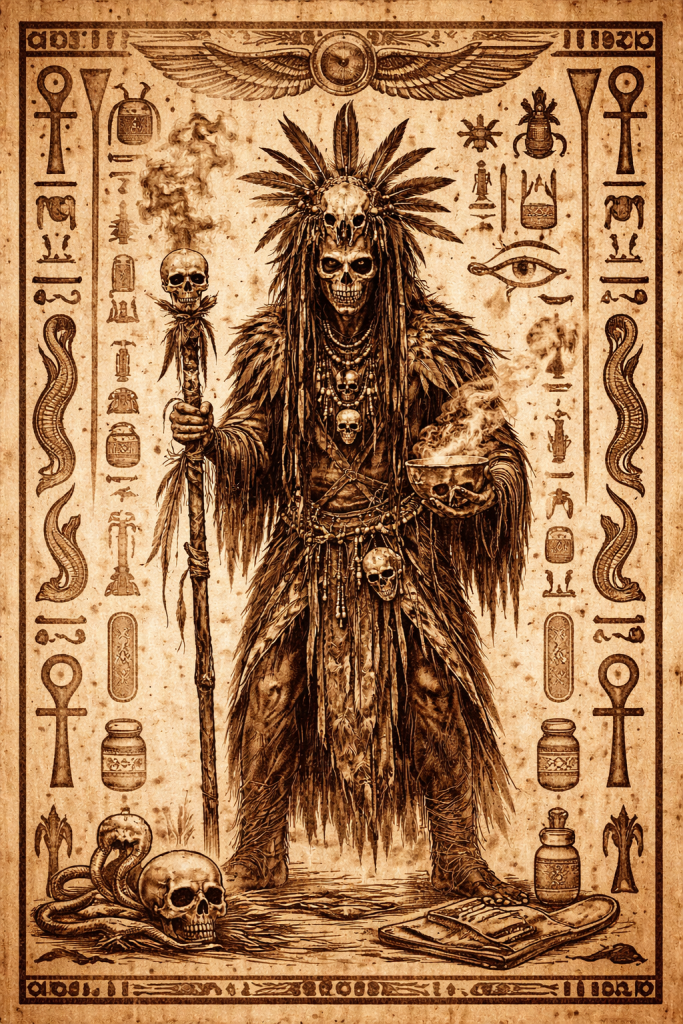
To understand the traditional healer often labeled as a “witch doctor” we must look beyond ritual practice and into the underlying spiritual architecture that supports it.
These traditions are not random collections of charms and ceremonies. They are grounded in structured cosmologies – coherent systems explaining the origin of life, the interaction of spiritual forces and humanities responsibility within the universe.
While beliefs differ across regions and cultures, several core theological principles appear consistently.
1. The Supreme Source and Hierarchical Spiritual Order
Many African spiritual systems recognise a Supreme Creator – a distant but foundational source of existence.
This being is not always directly worshipped in daily ritual. Instead, interaction occurs through:
- Ancestors
- Divinities or spiritual forces
- Nature Spirits
- Intermediary entities
For example, in Yoruba cosmology, the Supreme Creator (Olodumare) exists above a pantheon of divine forces known as Orisha. A Babalawo works within this ordered spiritual hierarchy, helping individuals navigate their destiny in alignment with divine structure.
This hierarchical arrangement reinforces the idea that spiritual authority is structured – not chaotic.
2. The Central Role of Ancestors
Ancestral veneration is foundational in many traditions associated with the Sangoma and Nganga.
Ancestors are not symbolic memories – they are active spiritual presences.
They may:
- Guide the living through dreams
- Protect family lineage
- Enforce moral codes
- Signal imbalance through illness or misfortune
- Call individuals into spiritual service
To neglect ancestral relationships is to risk spiritual disharmony.
The healers role often includes restoring broken ancestral bonds through offerings, ritual cleansing or mediated communication.
Ancestral reverence also reinforces social continuity – the living are custodians of tradition, accountable to both past and future generations.
3. Spiritual Etiology of Illness and Misfortune
One of the most misunderstood beliefs within these systems is the idea that illness may have spiritual origins.
This does not necessarily reject biological causes. Rather, it expands the framework of causation.
Misfortune may stem from:
- Spiritual imbalance
- Broken taboos
- Neglected ritual obligations
- Malevolent intent (witchcraft)
- Disturbed ancestral relationships
- Environmental or communal disharmony
The healer investigates not only physical symptoms but spiritual context.
For examples, a Sangoma may cast bones to determine whether illness arises from ancestral displeasure or external spiritual attack. A Nganga may consult ritual objects or spiritual forces to determine the root cause.
Healing, therefore, aims to restore balance – not simply suppress symptoms.
4. Witchcraft as Harmful Spiritual Manipulation
In many African cosmologies, witchcraft is defined as the malicious use of spiritual power.
This is crucial distinction.
The healer is not typically seen as the witch – but as the counterforce to witchcraft.
Witchcraft may be understood as:
- Envy manifesting spiritually
- Psychic or ritual attack
- Hidden spiritual corruption
- Social conflict expressed metaphysically
Because communities operate within a relational worldview, harm is rarely isolated to the individual. It can ripple through families and villages.
The healer intervenes to:
- Diagnose bewitchment
- Neutralise harmful spiritual forces
- Restore communal equilibrium
- Protect against future attack
This protective role is one of the core reasons colonial observers labeled them “witch doctors” – though the label misunderstands their function.
5. Divination as Structured Spiritual Communiation
Divination is not fortune-telling in the modern commercial sense. It is a formalised system of spiritual inquiry.
Each culture possesses specific methods:
- The Sangoma casts bones or symbolic objects
- The Nganga may interpret ritual configurations linked to spiritual forces
- The Babalawo uses the highly codified Ifa system, producing binary patterns connected to sacred texts
These systems require years of memorisation, training and initiation.
Divination operates on the principle that the spiritual realm communicates through pattern, symbol and synchronicity – and that trained interpreters can decode that language.
It is a disciplined spiritual science within its cultural framework.
6. Sacred Knowledge of Plants and Material Power
Traditional healers often possess extensive pharmacological knowledge passed down orally across generations.
Plants are not merely chemical agents – they are spiritually aligned substances.
A plant may have:
- Medicinal properties
- Protective associations
- Ancestral significance
- Ritual potency
Preparation methods – grinding, burning, bathing, ingesting – are not arbitrary. They are embedded in cosmological understanding.
The Ngangas nkisi, for example, may contain specific organic materials chosen for their symbolic and spiritual resonance. A Sangoma may prepare herbal mixtures tailored to ancestral guidance.
The material and spiritual are inseparable.
7. Destiny, Moral Order and Accountability
Many traditions recognise that individuals are born with spiritual path or destiny.
Within Yoruba cosmology, destiny (ori) plays a central role. The Babalawo assists individuals in aligning with that destiny through ritual and ethical correction.
Moral violations – betrayal, greed, injustice – can produce spiritual consequences.
Thus, cosmology reinforces social cohesion:
- Respect elders
- Honour ancestors
- Maintain ritual obligations
- Avoid envy and malicious intent
Spiritual law and social law are intertwined.
The healer often functions as moral advisor and mediator, ensuring community stability.
8. Balance as the Ultimate Principle
Above all, balance governs these cosmologies.
Balance between:
- Living and dead
- Human and nature
- Physical and spiritual
- Individual and community
- Power and responsibility
Illness represents imbalance.
Conflict represents imbalance.
Spiritual disturbance represents imbalance.
The healers role is not to dominate spirits – but to restore equilibrium.
This framework reframes the so-called witch doctor as something far more profound than folklore caricature.
They are custodians of cosmic balance within a living universe – operating inside systems of belief that are structured, disciplined and deeply interwoven.
Initiation and Calling
One of the most profound and often misunderstood aspects of the traditional healers path is initiation.
This is not a hobby, a casual spiritual interest or a self-declared title. In most traditions associated with figures such as the Sangoma, Nganga and Babalawo, becoming a healer is the result of a spiritual calling followed by structured, often years-long training.
Initiation transforms an individuals identity, responsibility and relationship to the spiritual world.
The Calling: Recognition of Spiritual Selection
In many African traditions, the healer does not choose the path – the ancestors choose the healer.
This calling may manifest through:
- Persistent dreams featuring ancestors
- Repeated visions or symbolic imagery
- Unexplained physical illness resistant to medical treatment
- Emotional or psychological distress interpreted as spiritual unrest
- Sudden sensitivity to spiritual presnce
- Divinatory confirmation by an established healer
Among Nguni-speaking communities in Southern Africa, the calling is sometimes described as thwasa – a spiritual emergence requiring acknowledgement.
Ignoring the calling is believed to intensify symptoms. Accepting it begins the path toward balance.
Importantly, the calling is not romanticised. It can be disruptive, frightening and socially challenging. It often requires the initiate to step away from ordinary life for extended periods of training.
Entering Apprenticeship
Once the calling is confirmed through divination, the initiate is placed under the guidance of an established healer.
This apprenticeship model is rigorous and hierarchical.
The initiate may:
- Live with or near the teacher
- Adopt specific ritual clothing
- Undergo purification rites
- Follow dietary restrictions
- Observe periods of sexual abstinence
- Avoid certain social interactions
These restrictions are not arbitrary. They are designed to discipline the body, mind and spirit, making the initiate receptive to ancestral communication.
Training can last anywhere from several months to multiple years, depending on the traditions and the depth of specialization.
Ritual Discipline and Spiritual Conditioning
Initiates undergo spiritual conditioning intended to heighten perception and strengthen resilience.
This may include:
- Repeated cleansing rituals
- Exposure to intense drumming and trance states
- Controlled spirit-possession experiences (under supervision)
- Night vigils
- Sacred bathing ceremonies
- Isolation periods of reflection
For a Sangoma initiate, learning to enter trance safely and interpret ancestral voices is critical. These altered states are not chaotic – they are structured experiences monitored by the mentor.
Among Ngangas, initiates may learn the spiritual properties of ritual objects and the ethical laws governing their use. They must understand not only how to activate sacred forces – but when not to.
Training is as much about restraint as it is about power.
The Witch Doctor in the Broader History of Witchcraft
In the global history of witchcraft, the witch doctor represents something foundational: the healer before the priest, the spiritual intermediary before institutional religion.
Across continents, similar figures have existed.
- Shamans in Siberia
- Medicine men among Indigenous American tribes
- Cunning folk in Europe
These roles reveal a universal human pattern – the need for someone who stands between worlds.
The witch doctor is one cultural expression of that archetype.
And understanding this role reshapes how we define witchcraft itself.
Final Thoughts: Reclaiming the Truth Behind the Term
The term “witch doctor” carries centuries of misunderstanding.
Strip away colonial bias, cinematic distortion and pulp horror exaggeration – and what remains is a spiritual healer deeply embedded in community, ancestry and tradition.
As we continue this witchcraft series, it is important to remember:
Witchcraft does not look the same across cultures.
Spiritual power is not always malevolent.
And the healer is often mistaken for the sorcerer.
Understanding the witch doctor is not about romanticizing or demonizing.
It is about context.
In the next entry in this series, we will explore another archetype of witchcraft – examining how belief, power and perception shape the roles we fear… and the roles we depend upon.