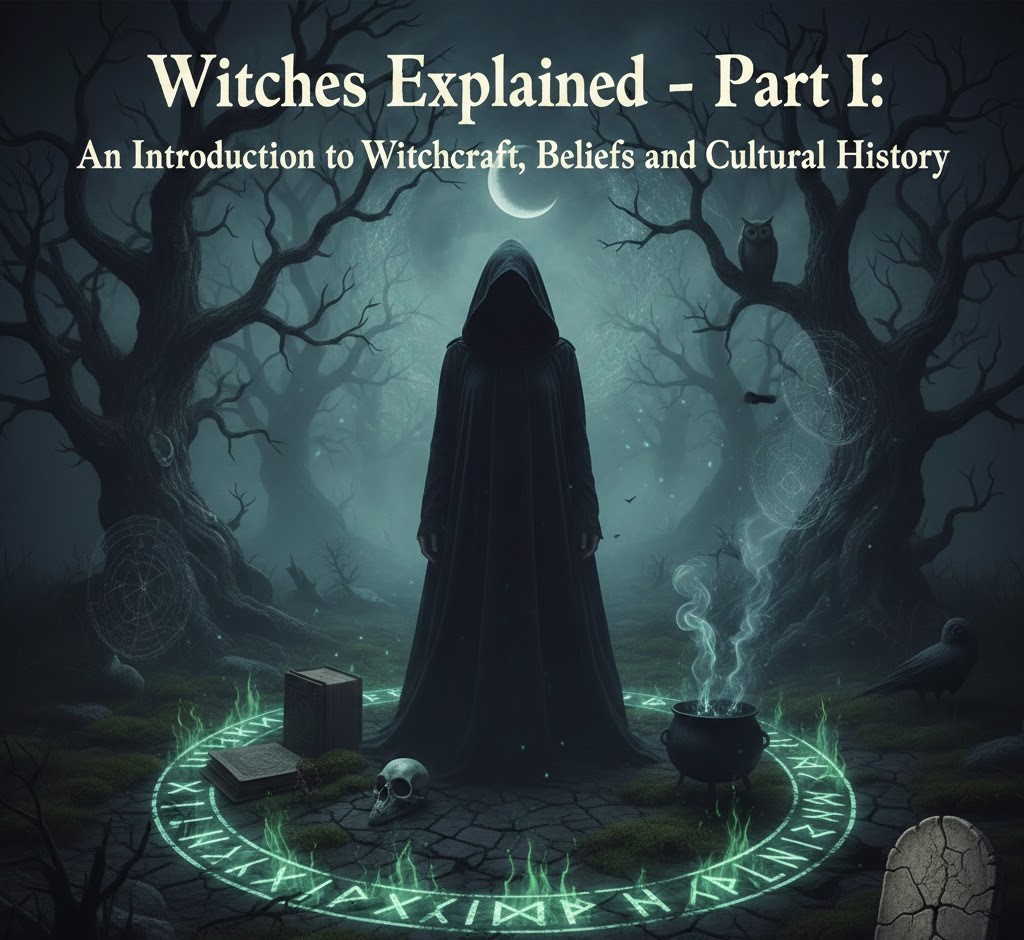
Witches have existed in human storytelling, folklore and spiritual traditions for thousands of years. From feared figures accused of dark magic to revered healers, mystics and spiritual practitioners, the concept of the witch has continually evolved. Today, witches are no longer confined to fairy tales or historical trial records – they are part of modern spiritual movements, cultural identity and renewed interest in ancient belief systems.
This introductory post explores what witches are, where witchcraft originated and how cultural perceptions of witches have changed over time. It serves as the foundation for an upcoming series that will examine different types of witches, their beliefs, practices and the historical roots that shaped them.
What is a Witch?
At its core, a witch is traditionally understood as someone who practices witchcraft – a broad term encompassing spiritual, ritualistic and magical practices intended to influence the natural or supernatural world. Historically, witchcraft has included healing, divination, herbal knowledge, spiritual communication, protection rituals and symbolic magic.
Importantly, witchcraft is not a single belief system or religion. Instead, it is a diverse collection of traditions shaped by geography, culture and time period. Some witches view their practice as spiritual, others as psychological or symbolic, while some see it as cultural heritage rather than belief. Modern interpretations of witchcraft often focus on personal empowerment, connection to nature, ancestral traditions or spiritual exploration rather than fear-based superstition.
The Ancient Origins of Witchcraft
Long before the word “witch” carried negative connotations, magical practitioners were respected members of early societies. Archaeological and historical evidence shows that ritual magic and early forms of witchcraft existed in ancient Mesopotamia, where incantations and spells were recorded on clay tablets, as well as in ancient Egypt, where magical healing, protective charms and written spells were part of daily religious life. In ancient Greece and Rome, witches and magical practitioners appeared both in mythology and everyday spiritual practice, often blending seamlessly into accepted religious traditions. Similar roles were found across Indigenous cultures worldwide, where shamans, medicine people and spiritual leaders fulfilled functions that later societies would label as witchcraft.
These early practitioners were commonly healers, midwives, astrologers or spiritual intermediaries. Their knowledge of herbs, seasons and symbolic ritual placed them in positions of authority within their communities, a status that would later contribute to suspicion, fear and eventual persecution as belief systems shifted.
Witches in Folklore and Mythology

Folklore played a major role in shaping how witches are perceived across different cultures. In many traditional stories, witches appear as powerful and mysterious figures who exist on the fringe of society, often inhabiting forests, isolated dwellings or liminal spaces believed to sit between the natural and supernatural worlds. European folklore frequently portrayed witches as solitary individuals associated with the night, transformation and hidden knowledge, while Slavic traditions introduced figures such as Baba Yaga, who blurred the line between villain, guide and guardian.
In Celtic mythology, magical women were deeply connected to the land, prophecy and sovereignty, often acting as conduits between the physical world and deeper spiritual forces. These mythological witches were not always depicted as evil; many represented wisdom, natural balance or the unpredictable forces of nature. Over time, however, these complex figures were simplified into darker stereotypes that reinforced fear and moral suspicion.
The Witch Trials and the Rise of Fear
The most destructive chapter in the history of witches unfolded during the witch trials of the fifteenth to eighteenth centuries, particularly throughout Europe and colonial America. During this period, widespread fear, religious extremism and social instability led to mass accusations of witchcraft. Tens of thousands of people, most of them women, were accused, imprisoned, tortured and executed based largely on superstition rather than evidence.
These persecutions were driven by a combination of religious doctrine, societal unrest, outbreak of disease and fear of unexplained misfortune. Misogyny and the desire to control female autonomy also played a significant role. As a result, the image of the witch shifted permanently from spiritual practitioner to malevolent servant of evil, leaving a cultural legacy that continues to shape modern portrayals of witches in paranormal and popular media.
Modern Witchcraft and Contemporary Witches
In the modern era, witchcraft has experienced a resurgence as people increasingly explore alternative spiritual paths and reconnect with ancestral traditions. Many contemporary witches reclaim the term as a symbol of independence, self-empowerment and spiritual autonomy. Unlike historical stereotypes, modern witchcraft is rarely rooted in fear or secrecy.
Todays witches may practice nature-based spirituality, folk traditions passed down through generations, symbolic or psychological magic or structured religious forms such as Wicca. Cultural and heritage-based practices also remain important to many. Through academic research, media exposure and online communities, witchcraft has become more visible and better understood, helping to separate historical reality from centuries of myth and exaggeration.
Are All Witches the Same?
One of the most persistent misconceptions about witches is the belief that they all share the same practices or belief systems. In reality, witchcraft is highly diverse and shaped by personal philosophy, cultural background and historical influence. Some witches focus on natural cycles and environmental awareness, while others emphasise herbalism, healing, ritual symbolism, ancestral traditions or personal spiritual development.
Understanding these differences is essential for anyone seeking to explore witchcraft beyond surface-level stereotypes. These distinctions form the foundations for understanding the many types of witches that exist, both historically and in modern practice.
The Main Types of Witches: Historical and Modern Traditions

Witchcraft has never been a single, unified practice, and throughout history different types of witches have emerged based on culture, geography and belief. Some of the earliest and most historically documented were folk witches and cunning folk, individuals embedded within their communities who worked with herbal knowledge, charms, protection rituals and practical magic. Hedge witches also appear frequently in folklore, often associated with liminal spaces, nature and solitary practice, occupying a symbolic position between the physical and spiritual worlds.
In contrast, ceremonial witches represent a more structured approach, drawing from written magical traditions, ritual systems and esoteric symbolism with roots in ancient religious and mystical practices. Modern spiritual movements later gave rise to Wiccan witches, whose practices combine reconstructed pagan beliefs with ritual observance and ethical frameworks developed in the twentieth century. Alongside these are solitary witches, who practice independently, and hereditary or ancestral witches, whose traditions emphasise lineage, regional customs and inherited knowledge.
More recent classifications such as green witches and kitchen witches reflect a focus on nature, the home and everyday ritual, echoing historical roles that existed long before these modern labels were applied. These categories are not rigid, and many witches identify with multiple traditions. They exist primarily as a framework for understanding the diversity of witchcraft, each of which will be explored in greater depth throughout this series.
Why Witches Still Matter Today
Witches remain culturally and historically significant because they reflect humanities ongoing relationship with belief, fear and the unknown. Whether examined through a historical, cultural or paranormal lens, witches provide insight into how societies respond to what they cannot easily explain or control.
By moving beyond exaggerated portrayals and exploring witches within their proper historical and cultural contexts, we gain a clearer understanding of both the past and the belief systems that continue to influence modern paranormal thought. This series begins with that understanding and builds toward a deeper exploration of who witches were, who they are today and why they continue to matter.
Final Thoughts
Witches have never been a single, easily defined group. Across history, the term has been used to describe healers, spiritual practitioners, outsiders and, at times, figures of fear shaped by cultural anxiety rather than evidence. When examined through a historical and paranormal lens, witchcraft reveals itself as a diverse and evolving set of beliefs and practices, deeply influenced by time, place and social context rather than a unified doctrine.
This post marks the beginning of a deeper exploration into the world of witches. In the articles that follow, each type of witch will be examined in detail, separating folklore from historical record and modern interpretation. Whether witches are viewed as spiritual practitioners, cultural symbols or misunderstood figures of the past, their legacy continues to provoke debate and fascination. Where do you think the line lies between myth and reality when it comes to witches? That question sits at the heart of this series – and the discussion is only just beginning.