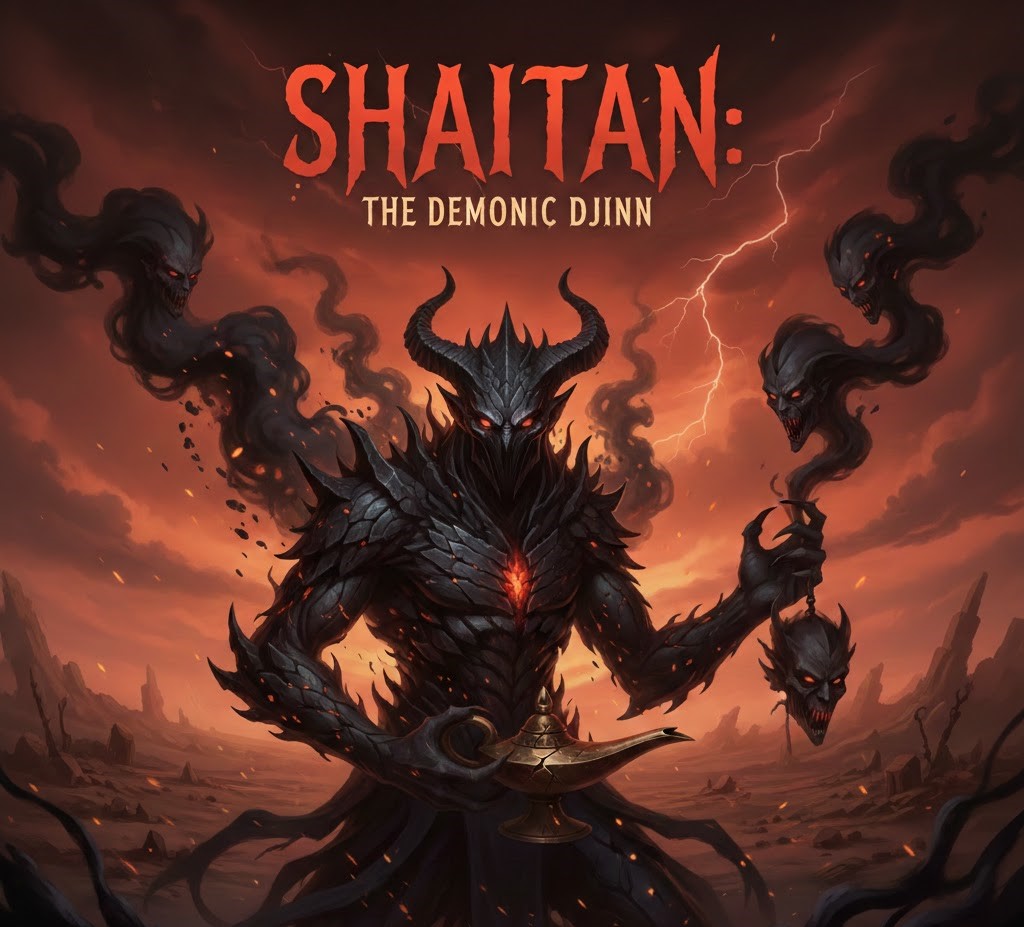
In modern paranormal discussion, the name Shaitan is often reduced to a convenient shorthand – “the Islamic Devil”. This simplification, while common, does a disservice to one of the most complex supernatural figures in human belief history. Shaitan is not merely a demonic antagonist in the Western sense, nor is it a singular being confined to a single narrative. Instead, Shaitan exists at the intersection of theology, folklore, psychology and lived experience, shaped by centuries of cultural interpretation and human attempts to understand temptation, fear and moral conflict.
For researchers and investigators within the paranormal field, Shaitan represents something particularly valuable: a framework through which anomalous experiences have been interpreted for over a thousand years. Whether one approaches the subject from a sceptical, spiritual or neutral position, the persistence of Shaitan across cultures and time suggests that it functions as more than a simple myth. It is a lens through which people have explained internal struggle, unseen influence and encounters with the unknown.
The World of Djinn: Where Shaitan Originates
To understand Shaitan, one must first understand the world of the Djinn. Long before the emergence of Islam, Arabian cultures believed that invisible beings inhabited the same physical spaces as humans, particularly desolate environments such as deserts, abandoned ruins, caves, wells and crossroads. These beings were believed to interfere with daily life in subtle but powerful ways, influencing illness, madness, creativity, fortune and misfortune.
Djinn were not originally viewed as inherently evil. They were unpredictable, possessing personalities, societies and motives of their own. Some were thought to protect certain locations, while others were blamed for sudden behavioural changes or unexplained events. In many ways, djinn functioned as an early explanatory system for phenomena that lacked a clear physical cause.
When Islam emerged in the 7th century, it did not discard djinn belief but incorporated it into a structural cosmology. Djinn were described as beings created from the elements, existing parallel to humanity, unseen but capable of interaction. Crucially, djinn were said to possess free will. This detail is central to the emergence of Shaitan, as it establishes the possibility of rebellion, moral failure and deliberate opposition.
Shaitan and Iblis: The Rebel Archetype

In Islamic theology, Shaitan is often associated with Iblis, but the two are not entirely synonymous. Iblis is a specific individual – a djinn who refused to bow to Adam when commanded by God. His refusal was rooted not in ignorance, but in pride. He considered himself superior due to his fiery nature and viewed humanity as unworthy of reverence.
This act of defiance resulted in Iblis being cast out of divine favour. However, unlike many fallen-angel narratives in other religions, Iblis was allowed to persist until the end of time, vowing to mislead humanity as a means of proving their unworthiness.
Shaitan, on the other hand, functions as both a title and a category. While Iblis is the origin figure, Shaitan refers more broadly to rebellious entities – djinn who adopt the same role of temptation, deception and moral corruption. This distinction is important, particularly in paranormal research, as it reframes Shaitan not as a lone cosmic villain, but as a recurring pattern of influence.
The Nature of Shaitans Influence
Unlike the over manifestations often depicted in horror media, Shaitans influence is described as subtle and internal. The Quran introduces the concept of waswasa, or whispering – intrusive suggestions that nudge individuals toward harmful thoughts or actions without removing their ability to choose.
From a modern perspective, this description is strikingly similar to what psychology identifies as intrusive thought patterns. Sudden impulses, unwanted ideas or internal dialogues that conflict with personal values are often externalised within cultures belief systems. Shaitan becomes the narrative container for these experiences, allowing individuals to acknowledge them without fully identifying with them.
Importantly, Shaitan is not described as having the power to force behaviour. Responsibility remains firm with the individual. This theological stance contrasts with many possession narratives in other traditions, where control is entirely surrendered to an external entity.
Encounters, Possession and Paranormal Case Narratives
Across Muslim-majority regions and diaspora communities, reports attribute Shaitan or Shayatin continue to surface. These accounts often involve possession-like states, whispering voices, sudden personality changes or overwhelming urges that feel foreign to the individual experiencing them.
Anthropological studies have shown that these experiences frequently align with psychological distress, trauma or neurological conditions. However, the cultural framing of the experience plays a critical role in how symptoms manifest and how relief is sought. In communities where belief in Shaitan is prominent, spiritual remedies such as Quranic recitation are often employed. In some cases, individuals report improvement, which researchers attribute to expectation, emotional reassurance and communal support.
From a paranormal research standpoint, these cases are significant not because they prove the existence of Shaitan, but because they demonstrate how belief systems shape lived reality. The experience itself is real to the individual, regardless of its underlying cause.
Sleep Paralysis and the “Night Djinn”
One of the most consistent modern experiences attributed to Shaitan or hostile djinn is sleep paralysis. Individuals describe waking unable to move, sensing a presence in the room, feeling pressure on the chest and experience intense fear. Shadowy figures, whispers or the sensation of being watched are commonly reported.
While neuroscience provides a clear explanation for sleep paralysis, its interpretation varies across cultures. In Islamic folklore, such experiences are sometimes attributed to Shaitan interfering with the sleeper. Similar interpretations appear worldwide, from “Old Hag” in European folklore to spirit attacks in Southeast Asian traditions.
The consistency of these experiences across cultures suggests a shared neurological phenomenon filtered through culturally specific supernatural frameworks. For paranormal investigators, this overlap highlights the importance of understanding belief context when analysing reports.
Shaitan and Equivalent Entities in Other Traditions

Shaitan is far from unique. Comparable figures appear in numerous belief systems, each fulfilling a similar psychological and moral function. In Christianity, Satan evolves from accuser into a fully externalised embodiment of evil. In Zoroastrianism, Ahriman represents chaos in direct opposition to cosmic order. In Buddhism, Mara acts as a tempter whose role is to distract rather than corrupt.
Indigenous traditions across the world describe spirits that exploit fear, weakness or moral transgression. These beings often function less as literal monsters and more as cautionary symbols, reinforcing social norms and personal accountability.
The recurrence of these figures suggests that Shaitan is part of a broader human pattern: the externalisation of inner conflict and unexplained experience into narrative form.
Modern Media and the Distortion of Shaitan
Contemporary horror media has largely stripped shaitan of cultural nuance. Djinn are often portrayed as interchangeable demons, stripped of their theological context and reduced to visual tropes. This misrepresentation not only fuels fear-based stereotypes but also undermines meaningful discussion about the roles these figures play in human belief systems.
For paranormal researchers, this distortion presents a challenge. Sensationalism obscures understanding, replacing investigation with assumption. Shaitan, in its original context, is far more subtle – and arguably more unsettling – than modern portrayals suggest.
Scientific Perspectives and Cultural Reality
From a scientific standpoint, there is no empirical evidence supporting the literal existence of Shaitan as a supernatural entity. Psychology, neurology and sleep science provide robust explanations for many experiences attributed to demonic influence. However, science does not negate cultural reality. Belief systems influence perception, behaviour and emotional response in powerful ways.
To dismiss Shaitan entirely is to ignore the role belief plays in shaping human experience. To accept it uncritically is equally limiting. Paranormal research exists in the space between these extremes, examining not just what people experience, but how and why they interpret it as they do.
Why Shaitan Remains Relevant in Paranormal Research
Shaitan persists because it addresses something universal: the experience of internal conflict, fear and temptation that feels external and invasive. Whether understood as literal djinn, a psychological archetype or a cultural narrative, Shaitan continues to provide a language for experiences that remain difficult to articulate.
For investigators, Shaitan is not proof of the demonic – it is evidence of humanities enduring need to explain the unseen.
Final Thoughts: The Whisper, Not the Monster
Shaitan is rarely the roaring demon of popular imagination. Instead, it is the whisper at the edge of thought, the presence without form, the suggestion that does not command but invites. Its power lies not in force, but in interpretation.
In studying Shaitan, we are not merely examining a supernatural entity. We are examining ourselves – our fears, our moral struggles and our relationship with the unknown. And in that sense, Shaitan may be one of the most enduring and revealing figures in paranormal history.