
In the field of paranormal research, few phenomena attract as much sustained interest as the poltergeist. Commonly referred to as the “noisy ghost”, poltergeist acticity has been documented for centuries in cultures around the world. Reports often include unexplained knocking or banging sounds, objects being thrown or moved without apparent cause, malfunctioning electrical devices and disturbances that appear to defy known physical explanations. Unlike traditions hauntings, these events are typically physical in nature and can escalate rapidly, creating an atmosphere of confusion and distress for those experiencing them.
When such disturbances are concentrated within a particular location and occur ocer a defined period, researchers describe the situation as a poltergeist visitation. These visitations are often marked by a progression of activity, begining with subtle noises or minor object displacement before intensifying into more disruptive and, at time, alarming manifestations. Notably, poltergeist cases are frequently associated with specific individuals rather than places, adding another layer of complexity to their investigation and interpretation.
This article explores what distinguishes a poltergeist visitation from other forms paranormal activity, how these events typically unfold and the leading theories proposed to explain them. From traditional spiritual interpretations to psychological and environmental explanations, we examine the evidence behind each perspective. By drawing on historical case studies and contemporary research, this post aims to provide a balanced and informed overview of one of the most persistent and controversial phenomena in paranormal investigation.
Understanding the Term “Poltergeist”
The word poltergeist is German: poltern meaning “to make noise” and geist meaning “ghost” or “spirit”. The translation, “noisy spirit”, accurately describes the hallmark behaviour of these occurences.
Unlike residual hauntings (which replay past events like echoes in time), poltergeist visitations involve active and physical disturbances. They seem to exhibit awareness, unpredictability and interaction with living people, which has made them both feared and intensely studied.
Comonly reported signs include:
- Loud knocking or rapping noises with no visible source
- Objects being moved, thrown or levitated
- Malfunctioning electronics or lights flickering without cause
- Sudden temperature fluctuations or pressure changes
- disembodied voices, whispers or growls
The Stages of a Poltergeist Visitation
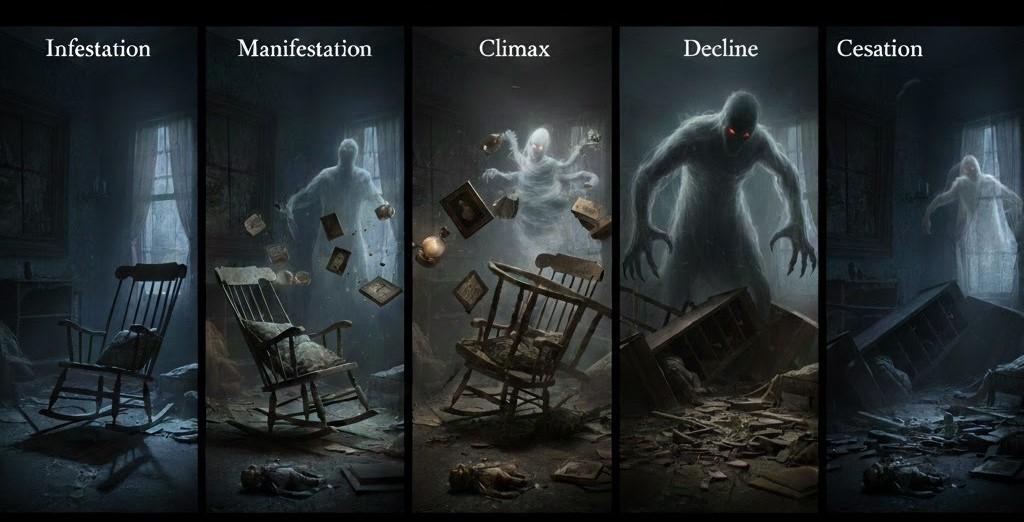
Poltergeist visitations tend to follow a recognizable progression observed across many historical and modern cases. While not every event unfolds the same way, researchers have identified five key stages that often appear in sequence.
Stage 1: Infestation (Subtle Disturbances)
Activity usually begins quietly and is easy to dismiss. Occupants might hear faint tapping, whispering or small objects shifting when no one is nearby. This stage often coincides with emotional stress or environmental change. For example, someone moving house, going through trauma or reaching adolescence. The energy seems to build, as though something unsen is drawing power or attention.
Stage 2: Manifestation (Active Disturbance)
Minor incidents begin to intensify. Knocks become louder, objects move across rooms and electrical disturbances increase. At this point, witnesses start to take notice, often feeling watched or unsettled. Investigators note that this phase can include temperature drops, fluctuations in EMF readings and unexplained mechanical failures.
Stage 3: Climax (Peak Activity)
This is the most intense phase of a poltergeist visitation. Activity becomes more chaotic with doors slamming, furniture shifts, items are thrown and voices or growls may be heard. The phenomena appear intelligent or responsive, sometimes interacting with investigators or reacting to attention.
Stage 4: Decline (Energy Dissipation)
After a period of peak activity, the disturbances begin to wane. The sounds grow softer, movements slow and the general atmosphere lightens. Investigators theorize that the energy sustaining the activity, be it emotional, environmental or paranormal, is depleting.
In this stage, people often describe an odd “emptiness” or “stillness” replacing the previous chaos.
Stage 5: Cessation (Quiet and Aftermath)
Eventually, all activity stops. Sometimes suddenly, sometimes fading gradually. In most cases, poltergeist visitations last from several days to a few months before disappearing completely. The longest recorded case of a poltergeist visitation lasted for 5 years.
Those who experienced them often describe lingering emotional or psychological effect such as fatigue, anxiety or relief. Interestingly, once the visitation ends, it rarely occurs in the same location.
Characteristics of a Poltergeist
While no two cases are idential, long-term analysis of documented poltergeist activity reveals a number of recurring characteristics that help investigators distinguish poltergeist phenomena from other types of paranormal encounters. These traits provide important context for researchers attempting to assess whether reported disturbances fall within the poltergeist classification.
- A Focused Epicenter
One of the most defining features of a poltergeist visitation is its tendency to centre one a specific individual rather than a location. This person – often referred to as the agent – is frequently present when activity occurs and may unconsciously act as the focal point for the disturbances. This distinguishes poltergeist cases from traditional hauntings, which are typically tied to a particular building or site. - Interactive Behaviour
Poltergeist activity often appears responsive to human presence, emotional states or direct interaction. Objects may move when witnesses are watching, sounds may intensify during heightened emotional moments and disturbances can seem to react to attempts at communication. This interactive quality sets poltergeists apart from residual hauntings, which tend to replay past events without awareness or response. - Temporary Duration
Unlike long-term hauntings that can persist for decades, poltergeist visitations are generally short-lived – longest recorded poltergeist visitation is 5 years. This activity often escalates quickly, reaches an intense peak and then diminishes just as abruptly. Most documented cases resolve within weeks or months, suggesting a transient trigger rather than a permanent presence. - Emotional Correlation
A significant number of poltergeist cases coincide with periods of emotional stress or psychological tension, particularly within adolescents or young adults. Researchers have long noted a correlation between heightened emotional states and the onset of activity, leading some to propose psychokinetic or subconscious influences as contributing factors. - Physical Force
Poltergeist phenomena are notably physical. Objects may be thrown with measurrable force, furniture may shift and impacts can leave visible or audible evidence. In many cases, multiple witnesses observe the same events simultanerously, lending weight to reports that describe physical interactions rather than purely subjective experiences.
Together, these characteristics form the framework by which investigators assess suspected poltergeist activity. Understanding these defining traits is essential for separating genuine cases from misinterpretation, environmental factors or more conventional explanations.
Theories Behind Poltergeist Activity
Despite extensive investigation, the cause of poltergeist phenomena remains debated. Researchers generally fall into three theoretical camps:
1. The Spiritual or Entity Theory
This traditional explanation says that poltergeists are independent and conscious entities. They are spirits or non-human entities expressing frustration or mischief. Their behaviour, while chaotic, is seen as intentional.
2. The Psychokinetic (PK) Energy Theory
Supported by parapsychologist, this theory suggests that human subconscious energy. particularly under emotional stress, manifests physically, causing the disturbances. In this model, the visitation reflects unresolved inner turmoil rather than external spirits.
3. Environmental and Psychological Factors
From a skeptical standpoint, poltergeist activity can be explained through natural causes: vibrations, faulty wiring, air pressure shifts or even suggestion effects amplified by fear and expectation. While these factors explain some cases, others remain resistant to conventional explanation, keeping the mystery alive.
Historical and Docuented Cases
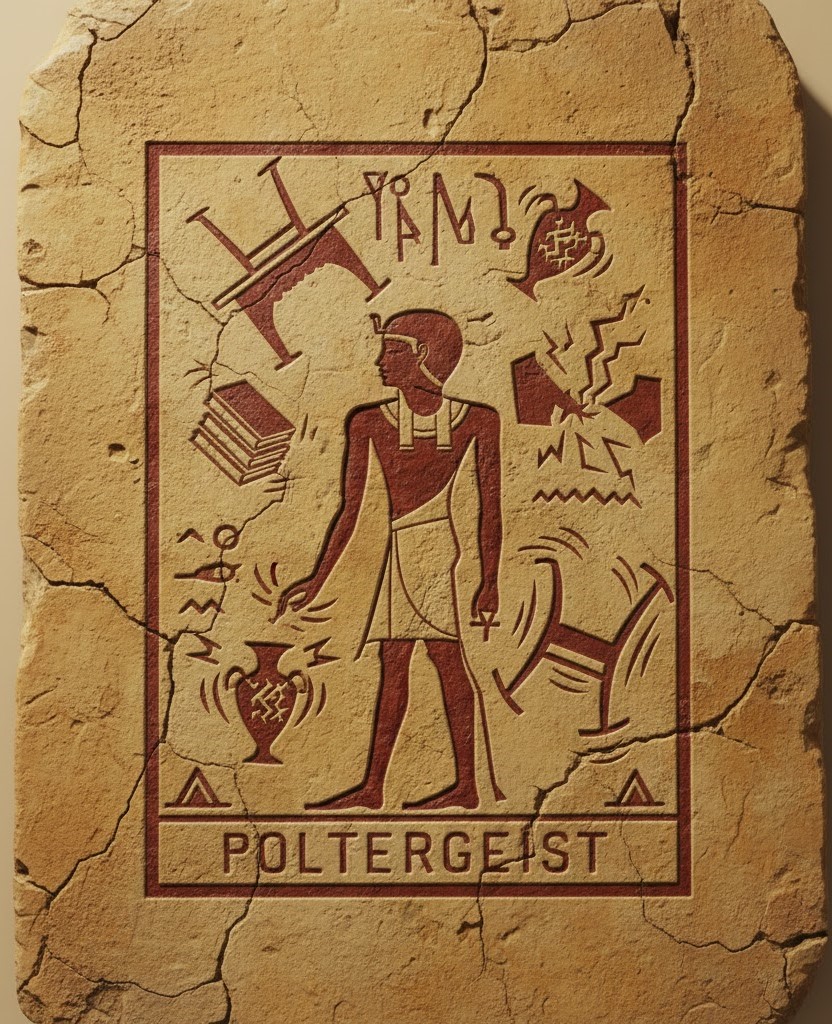
Several landmark cases continue to shape research into poltegeist visitation:
- The Enfield Poltergeist (London, 1977 – 1979) – A North London family reported furniture moving, levitating objects and disembodied voices. The case was documented by the Society for Psychical Research and remains one of the most studied paranormal events of the 20th century.
- The Rosenheim Case (Germany, 1967) – A law office experienced phone malfunctions, swinging lights and unexplained power surges, all witnessed by engineers and police.
These are two of the main events, each one shows the same general progression – calm beginnings, violent peaks and sudden resolution – aligning closely with the five-stage pattern of a typical poltergeist visitation.
Investigating a Suspected Poltergeist Case
Professional paranormal investigators use a mix of scientific and observational techniques to study reported poltergeist phenomena. These include:
- Baseline Environmental Readings (EMF, temperature and humidity)
- Audio/Video Monitoring for movement or sound anomalies
- Vibration and Electrical Testing to identify natural causes
- Psychological Assessment of affectd individuals to gauge emotional stress
- Controlled Experiments to attempt replication of events under observation
Investigators aim to debunk first, eliminating every natural or psychological explanation before considering a paranormal one.
How to Respond to Poltergeist Activity
If you suspect a poltergeist visitation in your home or workplace:
- Stay calm and rational. Fear often amplifies perception.
- Record events carefully. Note dates, times, sounds and witnesses.
- Check for physical causes. Inspect wiring, plumbing and structural issues.
- Seek professional help. Contact a reputable paranormal research team or spiritual advisor.
- Avoid Provocation. Don’t challenge or verbally engage with the activity.
- Consider a cleansing or blessing. Even symbolic rituals can help reset the emotional atmosphere.
Conclusion: The Enduring Enigma of Poltergeist Visitations
Whether viewd through a scientic, psychological or spiritual lense, poltergeist visitations remain one of the most compelling mysteries in the study of the paranormal. Their consistent stages, from quiet beginnings to explosive peaks and sudden cessation, suggest an underlying mechanism still not fully understood.
For researchers, each new case offers another opportunity to test theories and collect evidence that may one day explain this phenomenon. Until then, the poltergeist continues to stand as a reminder that not all things unseen are silent, and not all mysteries have yet been solved.
2 thoughts on “What is a Poltergeist Visitation? A Look at the Noisy Side of the Paranormal”